

The first hard freeze in Greenville usually lands in the second week of December, and it always catches me mid-sentence. One morning the pecan tree is bare and the feeders are busy. The next, the concrete bird bath by the patio is a solid disc of ice with a cardinal standing on top of it looking personally offended. For years my answer was a kettle of hot water at seven in the morning, which worked for about forty minutes and then refroze into a slick patch on the brick. In the fall of 2024 I finally bought the GESAIL heated bird bath and left it out through the entire winter, then through spring and summer with the cord unplugged and tucked away. This is what several months of daily use actually looked like.
The short version before the long one: it works, it is not fancy, and there is one limitation you ought to know about before you buy. I am not a veterinarian and I am not going to pretend this is anything more than a heated dish of water. But it is a heated dish of water that stayed open through two ice storms, and that counts for something when the alternative is carrying a kettle outside in my robe.
The Quick Verdict
A plain, sturdy 75-watt heated bath that kept water open through two ice storms and three mounting options worth having. The bowl is small enough that heavy traffic means refilling every day, and you need an outdoor outlet within reach of an extension cord.
Amazon Check Today's Price →Water That Stayed Open Through Two Ice Storms
75 watts, a sealed heating element with thermostatic control, and three ways to mount it: deck, clamp, or ground legs. The bowl lifts off for rinsing in about four seconds. See the current rating and today's price on Amazon.
Amazon Check Today's Price on Amazon →How I've Used It
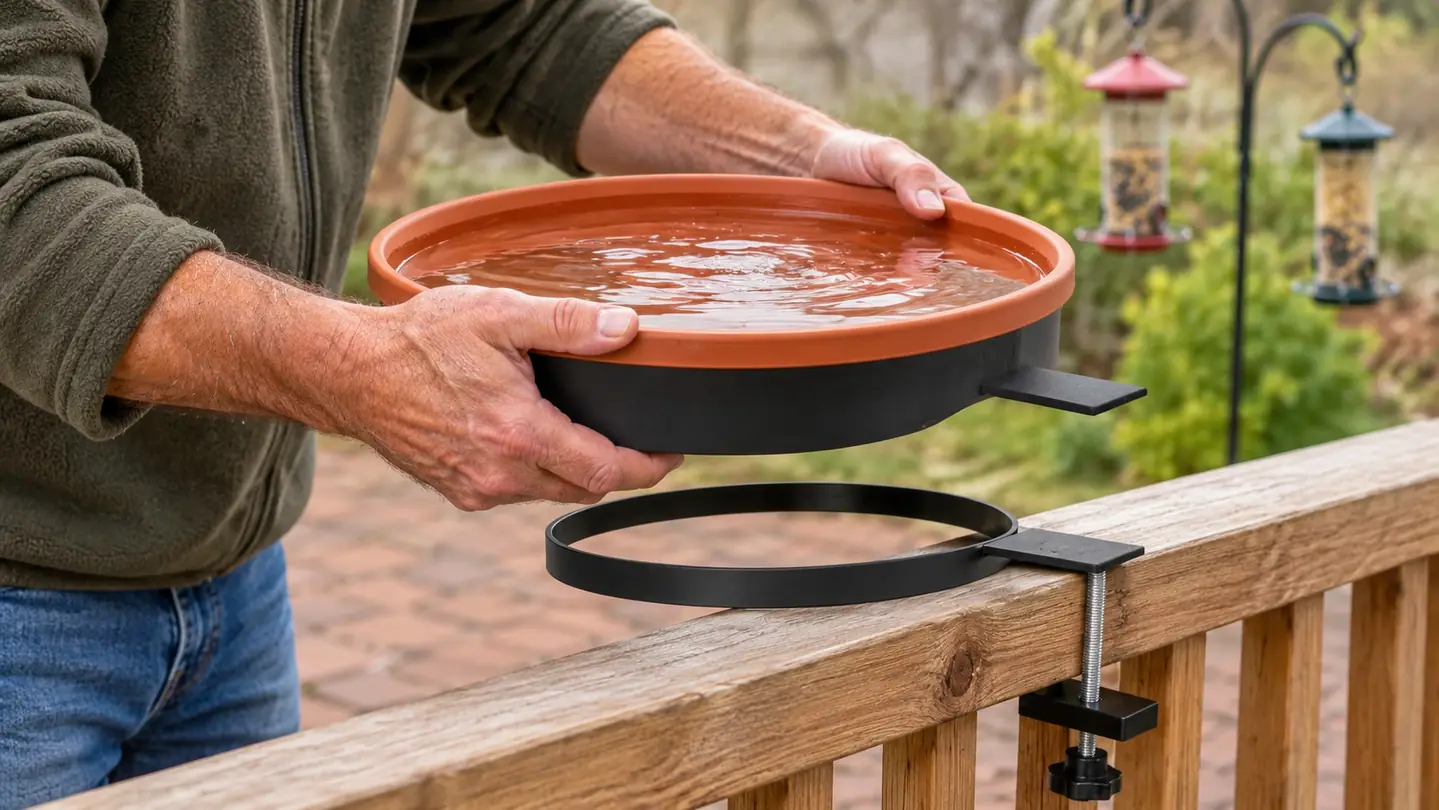
It went out in late October, first on the ground legs at the edge of the patio, in roughly the spot where the old concrete bath had stood for twenty years. That lasted until January, when I got tired of the squirrels using the rim as a step stool to reach the feeder above it. I moved it to the clamp mount on the fence rail, which put it about four feet off the ground and out of the squirrel highway. Both setups took me under fifteen minutes with a screwdriver, and I did neither of them correctly the first time.
My routine is not complicated. Every other morning I carry out a quart jar of water and top it off. Twice a week, or more often if the finches have been splashing, I lift the bowl off the ring, dump it, scrub it with a stiff brush and plain hot water, and set it back. The bowl is 13 inches across and 2 inches tall, and the whole unit weighs 5.1 pounds, so lifting it off is a one-hand job even at sixty-seven with a cranky shoulder.
The traffic was the part I did not expect. I have fed birds out this kitchen window for two decades and I thought I knew who was back there. Put open water out in January and you find out. Cardinals came first, then the Carolina wrens, then chickadees in a steady rotation, and house finches in numbers that surprised me. My budgie Pickle is indoors with his own dish and has no opinion on any of this, so the outdoor crowd gets the heated bath and he gets the kitchen counter. He is seven grams of attitude and he is not sharing.
What 75 Watts Actually Does
The listing is straightforward: a built-in heating element, 120 volts, 75 watts, safely enclosed and sealed inside the unit, with thermostatic control. What that means in practice is that it does not blast heat. It holds a ring of open water in the middle of the bowl and keeps the edges from sealing over. On a twenty-four-degree morning I went out with my coffee and found a clear center roughly the size of a salad plate, with a rind of ice around it that I could knock loose with a boot. That is exactly what I wanted. If you are picturing a warm little spa, this is not that, and it should not be. A shallow bath that stays liquid is the goal.
The thermostat does the work I do not want to think about. It comes on when it needs to and cycles off when it does not, and I have never once heard it running from the kitchen window. During the mild stretch in early February, when it was fifty degrees for a week, I do not think it ran at all. It just sat there being a bird bath, which is the correct behavior. I ran it to the outdoor outlet on a heavy extension cord rated for exterior use, and I check that connection every couple of weeks because a cord lying in wet grass is the sort of thing that fails quietly.
The one thing I would tell a neighbor before they buy: you need power. This is not a solar trickle, and there is no battery. If your best bird-watching window faces a spot with no outlet within reach, budget for the cord and the patience to run it, or buy something else. That is the honest limitation, and it is the reason I docked it a point and a half rather than handing out a perfect score.
Three Ways to Mount It, and the One That Stayed
The design allows for a deck mount, a clamp mount, and legs for a ground mount, and all three sets of hardware come in the box. The deck mount is the one for anyone with a railing they can drill into, and it puts the bath at exactly the height you want for watching from a window. The clamp mount is what I ended up keeping, on a fence rail, and it has not shifted in wind. The ground legs are the simplest and the least stable if you have a dog or a determined squirrel, and they set the bath low enough that the cats in the neighborhood can think about it.
The clamp mount is also the one that solved the squirrel problem for me, though I want to be honest that it solved it by luck rather than design. Four feet of air between the bath and the ground turned out to be enough distance that the squirrels quit bothering and went back to the feeders where the food actually is. The birds did not care at all. Nobody needed an adjustment period. The first cardinal was on it before I got back inside.
If I were mounting it on a deck rail instead, I would use the deck mount and be done with it. If your yard is level and your knees are better than mine, the ground legs are fine and probably look the best from the kitchen window. The point is that you get to decide, and you do not have to buy a second product to change your mind later.
Cleaning, the Cord, and Those Little Gaskets
A bird bath is only as good as how easy it is to empty, because you will empty it constantly. The detachable bowl is the whole reason this thing works for me. It lifts off the metal ring, gets dumped and scrubbed, and goes back on. No hoses, no buckets, no hauling the entire unit indoors. In the summer, when I am cleaning it every other day because algae moves fast in North Carolina heat, that four-second removal is the difference between a habit I keep and a chore I start skipping by July.
The three EVA gaskets that come in the box are worth mentioning because I ignored them for two weeks and could not figure out why the water kept listing to one side. My patio is not level. Nothing about this property is level. The gaskets stick to the metal ring, mostly invisibly, and hold the tray flat. Use them when you need them, and you probably need them. That was my own fault, not the product's, but nobody in the reviews I read explained what they were for.
Come March, the cord tucks away and the unit is a plain bird bath again, which is how I have run it since. It has been rained on, baked, and hit with pollen so thick the water went yellow for two weeks in April. It still sits level enough that a finch can land without spilling half of it. The bowl surface has picked up a mineral film from our hard water that takes a scrub with white vinegar to lift, and that is a thing about Greenville water, not a thing about GESAIL.

Where It Fell Short
The bowl is small and the traffic is not. Thirteen inches across sounds generous until eight finches decide it is their personal bathtub at the same moment. On heavy mornings I am topping it off daily, and during that icy week in January I refilled it twice on two separate days. If you feed a crowd, or if you travel, this will not coast. There is no reservoir and no float valve and nothing to top it off but you and a jar.
The other honest complaint is that it does nothing about the mess the birds make of the water within a day. Seeds, hulls, and the occasional unfortunate outcome of a flock all end up in the bowl, and the thermostat will happily keep a bowl of cloudy water just as open as a bowl of clean water. That is on me to fix, and I fix it, but a buyer should know going in that the heated part and the clean part are two different jobs and only one of them is automated.
What I Liked
- Kept a ring of open water through two ice storms and a week of nights in the teens
- Thermostatic control means it cycles on its own and stays quiet
- Bowl lifts off the ring in seconds for dumping and scrubbing
- Three mounting options in the box: deck, clamp, and ground legs
- Cord tucks away cleanly for spring and summer use as a plain bath
Where It Falls Short
- Needs an outdoor outlet within reach of an exterior-rated extension cord
- Bowl is small for heavy traffic, so expect daily refills in a busy yard
- The gaskets are genuinely necessary on uneven ground and the instructions barely mention them
- Hard water leaves a mineral film that needs vinegar, not just rinsing
Two ice storms, one week below freezing both times, and I never once had to break ice out of it with a hammer.
Who This Is For
This is for the person who already feeds birds and has figured out that water is the harder half of the equation. If you have a spot you watch from a kitchen window, an outdoor outlet you can reach, and a winter that ices things over for weeks at a stretch, the GESAIL does the one job it promises without any fuss. It suits a yard with moderate traffic best, the kind with a pair of cardinals and a rotating cast of chickadees rather than a flock of thirty. It also suits anyone who wants to mount it high and forget the squirrels, because the clamp mount is genuinely useful.
It also suits the person who wants one thing that works rather than a system. There is no app, no schedule to program, no sensor to calibrate. You plug it in, you keep it full, and you scrub it when it needs scrubbing. Earl has not had to touch it once since I set it up, which is his highest possible praise for anything with a cord.
Who Should Skip It
Skip it if there is no power anywhere near where you want it. Running a cord across a walkway or out to the middle of a quarter acre is a trip hazard and a code question, and neither one is worth it. Skip it if you are gone for weeks at a time, because it needs attention and it will run itself dry and then sit there heating nothing. And skip it if your winter is more of a cold drizzle than a freeze. In a climate that rarely ices over, you are paying for a heating element you will use twice a year.
And skip it if the birds in your yard are indoors. Pickle has his own setup and a strong opinion about anything new near his cage, and mine has never once been plugged in inside the house. This is a backyard product, plain and simple. For a pet bird indoors, ask your avian vet what they recommend for bathing and skip the outdoor gear entirely.
One Dish of Water, Open All Winter
It is not complicated and it is not expensive to run. It is 75 watts, a sealed element, a bowl that lifts off, and three mounting choices so it fits the yard you actually have. If the cardinals are standing on ice out there right now, this fixes that.
Amazon See the GESAIL Heated Bird Bath on Amazon →