
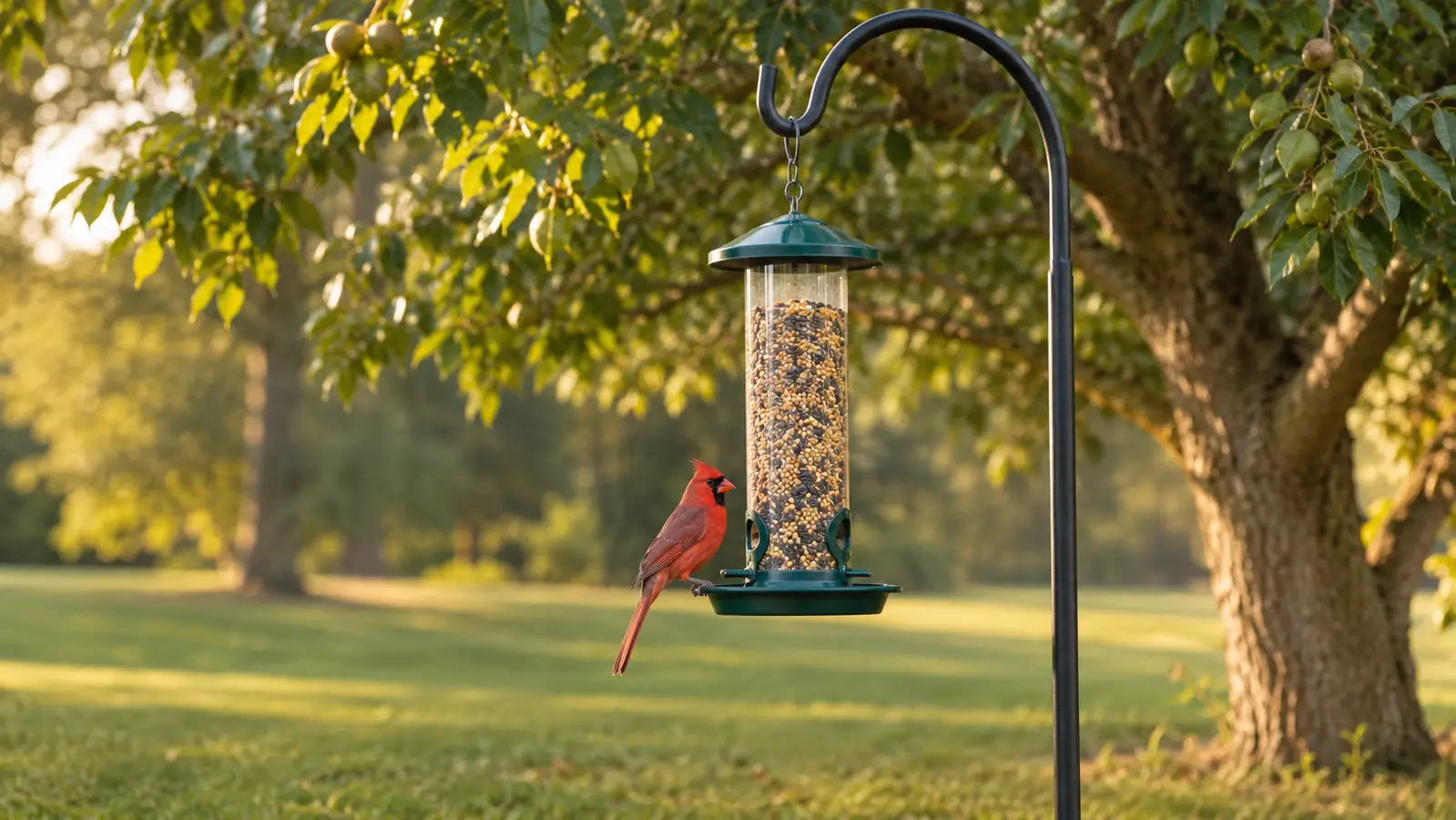
Two summers ago I stood at my kitchen window with a cup of coffee and watched a squirrel hang upside down off the pecan tree, shimmy down the shepherd's hook, and clean out a tube feeder in under twenty minutes. I had filled that feeder before breakfast. By ten o'clock there was nothing left but a ring of sunflower hulls on the patio and one extremely satisfied squirrel. I tried the usual remedies. Cayenne pepper. A baffle. Moving the pole two feet farther from the tree. The squirrels treated every one of them like a puzzle I had kindly built for their entertainment. So I ordered the Brome Squirrel Buster Standard, mostly out of stubbornness.
That was six months ago. The feeder has hung in the same spot ever since, through a wet spring, a hot Piedmont summer, and the first cool mornings of October. I did not run a controlled study and I am not going to pretend I did. I sat at that window most mornings with my coffee and a spiral notebook, and I wrote down what I saw. My husband Earl thinks a person should have better things to do before eight in the morning. He also refills the feeder now without being asked, so take that for what it is worth. Here is what six months of daily use actually looks like, including the parts I did not care for.
The Quick Verdict
Six months in, the squirrels are still shut out and the cardinals are still coming. The feeder is small enough that I refill it constantly in peak season, and that is my one real complaint.
Amazon Check Today's Price →The feeder that ended a two-summer standoff at my kitchen window
Hangs on the same hook I already had, holds 1.3 pounds of seed, and slides shut under a squirrel's weight. Six months of daily use and not one successful squirrel meal.
Amazon Check Today's Price on Amazon →How I've Used It
It hangs on a shepherd's hook about six feet off the patio, roughly ten feet from the kitchen window and maybe twelve feet from the pecan tree. That distance matters more than anything else you will do. The closer a feeder sits to a branch, the more launching points a squirrel has, and no feeder on earth beats a squirrel that can drop straight down onto the roof. The unit measures 5 inches by 5 inches by 13.25 inches and weighs 1.6 pounds empty, so it is not a heavy thing to lift down with one hand. I fill it with a cardinal blend, mostly black oil sunflower with some safflower, because that is what the cardinals in my yard actually eat and because the finer mixed seed just ends up on the ground for the doves.
A normal week for me is one fill on Sunday and a top-off around Wednesday or Thursday. The capacity is 1.3 pounds, which sounds like more than it is once cardinals and house finches are working a feeder in shifts. In July, with fledglings everywhere and a mother bird on every perch, I was out there every other day. In February, when traffic drops to a few chickadees and one very territorial Carolina wren, a single fill lasts most of the week. If you are used to a big hopper feeder that holds ten pounds and needs attention twice a month, this will feel like a small feeder. It is a small feeder.
I clean it every three to four weeks, more often in the hot months. Warm, damp seed grows things you do not want near your birds, and no feeder design changes that. This one comes apart without tools, so it goes into a bucket of soapy water, gets scrubbed with a bottle brush, and dries on the patio table. Start to finish that is about fifteen minutes of my morning. Nothing has broken in six months. The plastic has not cracked in the sun, the spring still moves freely, and the hanger held through two gusty storms that took shingles off the shed. I cannot tell you how many winters it will last. I can tell you the manufacturer backs it with a lifetime limited warranty, which is not something the feeders I owned before this one offered.
How the Spring Mechanism Actually Works
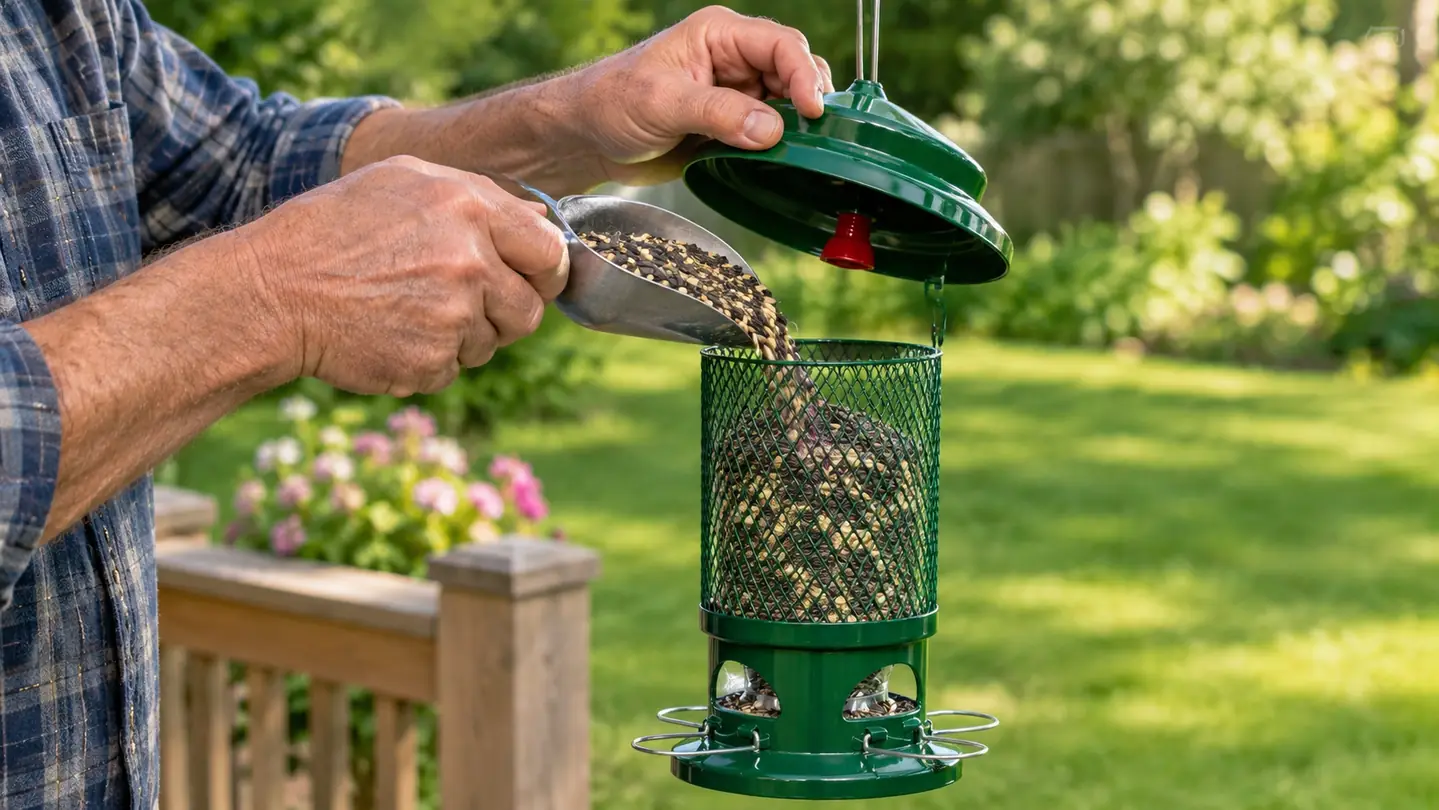
Here is the part that matters, and it is the part the flimsy feeders leave out. Inside the housing there is a spring, and the spring decides how much weight the outer shroud will hold up before it slides down. The openings in the shroud line up with the feeding ports underneath so birds can reach the seed. Add too much weight and the shroud drops, the openings no longer line up, and the seed is covered. Brome calls it a patented weight adjustable spring mechanism, and after six months of watching it work I believe them about the patent.
The squirrel is not harmed, not thrown, not squirted with anything. It simply rides the shroud down, finds a smooth closed surface where a meal used to be, and eventually gives up and goes to clean up under the feeder with the doves. The first time I watched it happen I laughed out loud in my own kitchen. The squirrel sat on the perch, rode the shroud down about an inch, looked at the feeder, looked at me through the window, and left. That was early June. It has not gotten a meal since.
The ports have perches for the perching birds, and the wire shroud gives the clinging birds something to grab. My chickadees and the wren take it that way, gripping the mesh and leaning in sideways, which is a pleasure to watch. The seed tube is clear and the listing notes that the clear tube traps solar energy. I have not measured the inside temperature of a bird feeder and I am not about to start, so I will not swear to that one. What I can tell you is that the seed has never looked damp or clumped the way it did in my old wooden feeder after a week of Carolina humidity.
What the Birds Did, Month by Month
The first two weeks were slow, and I want to be honest about that so you do not panic. A new object on the hook makes local birds conservative. A chickadee found it on day four. A house finch showed up on day six and brought friends by day nine. The cardinals took almost two weeks to commit, and cardinals are the reason I bought this feeder, so those were long days. Once they came, they stayed. By the end of the first month I was seeing four or five cardinals at a time waiting in the pecan tree for a turn at the perch, which is more than I ever saw at the old feeder.
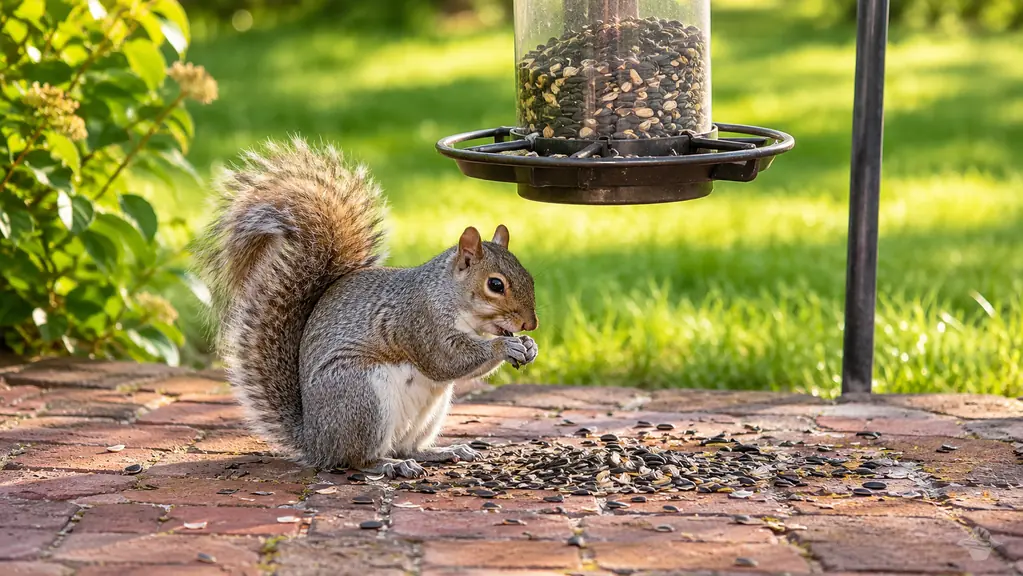
The squirrels took longer to quit. For the first three or four weeks they came every single day, and every single day they rode the shroud down and got nothing for their trouble. One of them got clever and tried to hang from the hanger by its back feet and reach down over the top. That did not work either. By the second month visits were down to a couple a week. By the third month they mostly walked past the hook on their way to the ground beneath it, where the cardinals fling the hulls. I still have squirrels in the yard. I just do not have them on the feeder, and that is the whole battle.
What has changed most is the seed and the mess. I used to fill a feeder and lose most of it to squirrels by mid morning. Now the seed goes into birds, the hulls land under the hook, and the patio stays tidier. I also see more species at once than I used to, because the feeder is not being emptied before the shy birds get a turn. The wrens come early and low. The cardinals come mid morning. The finches arrive in a noisy crowd around lunch. Pickle, my budgie, has strong opinions about all of it from his cage by the window, though he is strictly an indoor bird and has never met a single one of them.
I still have squirrels in the yard. I just do not have them on the feeder, and that is the whole battle.
Seed, Cleaning, and Wear After Six Months
Six months means six months of weather, not six months of a feeder sitting in a garage. We had a stretch in July where the heat index sat above 100 for nine days running, and the clear tube is still clear rather than clouded. We had two storms with enough wind to peel shingles off the shed, and the feeder rode both of them out on the hook because I forgot to bring it in. The only thing showing any age is the hanger wire, which has a little surface rust where the coating wore thin. It is cosmetic. It has not changed how the feeder hangs or how the shroud moves.
The spring is the part I watch, because the spring is the entire mechanism. If it stiffens or rusts, the shroud stops sliding and the feeder becomes a very sturdy perch for squirrels. Mine still moves freely after six months outdoors, and I have adjusted it twice, once lighter in spring when the finches were small and once heavier in summer. Both times it took about two minutes at the kitchen sink. If you set it too light, the bigger birds will drop it themselves and look confused. If you set it too heavy, a determined squirrel can hang on without tripping it. Expect to fiddle for a week before you find your setting.
Brome backs the feeder with a lifetime limited warranty. I have not had to use it, so I cannot tell you how a claim goes. I can tell you it was part of why I picked this one over the cheaper feeders I had been cycling through, because I had replaced three of those in four years and I was tired of it. A feeder that lasts is cheaper than a feeder that does not, and that is true whether or not the company answers the phone.
What I Did Not Love
I have one real complaint and two small ones. The real one is capacity. At 1.3 pounds, this feeder needs refilling more often than I want to walk outside, and in peak season that means every other day. If you travel, or if you keep feeders so you do not have to think about feeders, 1.3 pounds will not carry you. You will either buy a second one, which is what I did, or you will accept the chore as part of the hobby. I accepted it, but I want you to know it is coming.
The small complaints. The wire shroud sits between my eye and the birds, so the view is not as clean as an open feeder where you can see every feather. I got used to it in a week, but if unobstructed viewing is the entire point for you, this will nag at you. And the feeder does not solve squirrels, it solves squirrels at this feeder. Mine still work the ground underneath every afternoon, picking up what the cardinals drop. If your goal is a yard with no squirrels in it, no product on Amazon is going to hand you that.
What I Liked
- Shuts squirrels out of the seed. Six months in, not one successful squirrel meal.
- Weight adjustable spring lets you tune the tension so cardinals and finches can feed but squirrels cannot
- Clear tube and wire shroud come apart without tools and clean in about fifteen minutes
- Held up through nine days of brutal heat and two wind storms with no cracks or broken parts
- Lifetime limited warranty from Brome, which the feeders I owned before this one did not offer
Where It Falls Short
- 1.3 pound capacity means refilling every other day during peak season
- The wire shroud sits between you and the birds
- Squirrels still clean up on the ground beneath the feeder
- The first two weeks are slow while local birds get used to a new object on the hook
Who This Is For
This feeder is for the person who already has a hook or a pole, who is losing real seed to squirrels every week, and who does not mind walking out to refill. That last part is not a small caveat. If you are home in the mornings, if you keep a scoop by the door, and if filling a feeder counts as a pleasant excuse to stand outside for two minutes, the capacity is a non issue and the rest of the feeder is very good. It suits smaller yards where you want cardinals, chickadees, finches and wrens up close to a window, and it suits anyone who has already tried the pepper and the baffle and the pole relocation and is tired of being outsmarted.
Who Should Skip It
Skip it if you want one big fill to last a month, because 1.3 pounds will not do that and you will resent it by week two. Skip it if you have no hanging point and no plan to add one, since this is a hanging mount and it needs a hook, a branch or a pole bracket to work. Skip it if bears visit your yard, because no feeder of any brand is bear proof and hanging seed in bear country invites a problem you do not want. Skip it if you will not commit to cleaning, since a feeder that never gets washed is a feeder that makes birds sick. And skip it if you want a squirrel free property rather than a squirrel free feeder. This solves the second problem well and does nothing at all about the first.
Six months, one feeder, and the squirrels are still losing
If you are tired of refilling a feeder that gets emptied by something other than birds, this is the one I would hand you over the fence. Hang it, fill it, give the birds two weeks to trust it.
Amazon Check Today's Price on Amazon →