
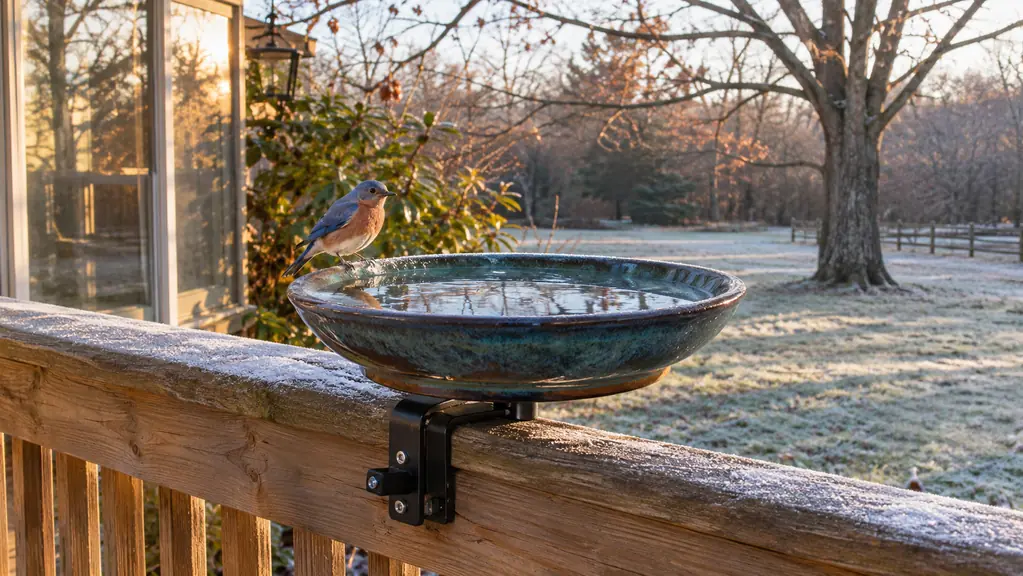
Every January I do the same foolish thing. I let the bird bath out by the pecan tree freeze into a solid disc, feel guilty about the cardinals lined up on the fence rail, and carry a saucepan of hot water across the patio in my slippers. By the time I get back to the kitchen window the water is already skinning over with ice. Last winter I stopped patching the problem and bought a GESAIL heated bird bath, the kind with the heating element sealed inside the bowl, and then I borrowed a neighbor's deicer for two weeks so I could compare the two honestly instead of guessing. I am 67 and retired, not a wildlife biologist, so take this as one back yard in eastern North Carolina and not a laboratory report. But I do know what works in my own yard, and I know what I got tired of carrying.
The short answer is this. If you already own a bath you like, one that is heavy enough not to tip and deep enough to hold water, a deicer is the simpler path and I will not pretend otherwise. You set it in the water, run a cord, and you are done in ten minutes. If you are starting from nothing, or your old bath is cracked, shallow, or tips every time a squirrel jumps on it, the GESAIL heated bird bath solves the whole job at once. It is a 13 x 13 x 2 inch bowl weighing 5.1 pounds, with a 75 watt, 120 volt heating element sealed inside it and a thermostat that decides when that element runs. It mounts three different ways, and that turned out to matter more than I expected.
| GESAIL Heated Bird Bath | A bird bath deicer | |
|---|---|---|
| Works with the bath you already own | No. The 13 x 13 x 2 inch bowl is the bath. | Yes. It drops into the basin or bowl already in your yard. |
| Cold weather control | Thermostatically controlled 75W element, 120 volts, sealed inside the bowl. | Varies by model. Some run the whole time they are plugged in. |
| Installation | Three options: deck mount, clamp mount, or legs for ground mount. Hardware comes with it. | Nothing to install. Set it in the water or hang it over the side. |
| Staying put in wind | Deck and clamp mounts hold the bowl fixed. Three EVA gaskets on the metal ring keep the tray level on a rail that is not level. | Floating units drift to one side. Hanging units swing in a gust. |
| Year round use | Cord tucks away for spring and summer and the bowl stays out as a plain bird bath. | Comes out at the end of the season and goes on a nail in the shed. |
| Cleaning | Detachable bowl lifts off the ring and goes to the utility sink. | Lift the unit out and scrub the bath it sat in. |
| Storage footprint | 5.1 pounds plus the legs or clamp hardware, so it lives outside anyway. | Small enough to hang out of the way in a shed. |
| Power | 120 volts and 75 watts. Needs an outdoor outlet within reach of the cord. | Check the label on the unit you buy. Draw varies a good deal. |
Where the GESAIL Heated Bird Bath Wins
The thermostat is the part I notice most, because it is the part that keeps the water open at six in the morning without me thinking about it. A 75 watt element sealed inside a bowl is not a dramatic amount of heat. It does not need to be. It only has to stay ahead of the air, and a thermostatically controlled element gets to decide for itself when to work rather than running flat out the entire time it is plugged in. What that means in practice is that the bowl holds open water rather than a warm spot in the middle with ice creeping in from the rim. I fill it in the evening and it is still drinkable at breakfast. The night that convinced me was our first hard freeze in December, when the forecast said 19 and I fully expected to be out there at dawn with the jug. I looked out the kitchen window at a quarter to seven and there was open water, a little steam curling off the top, and a house finch already drinking. I had not touched it since supper the night before.
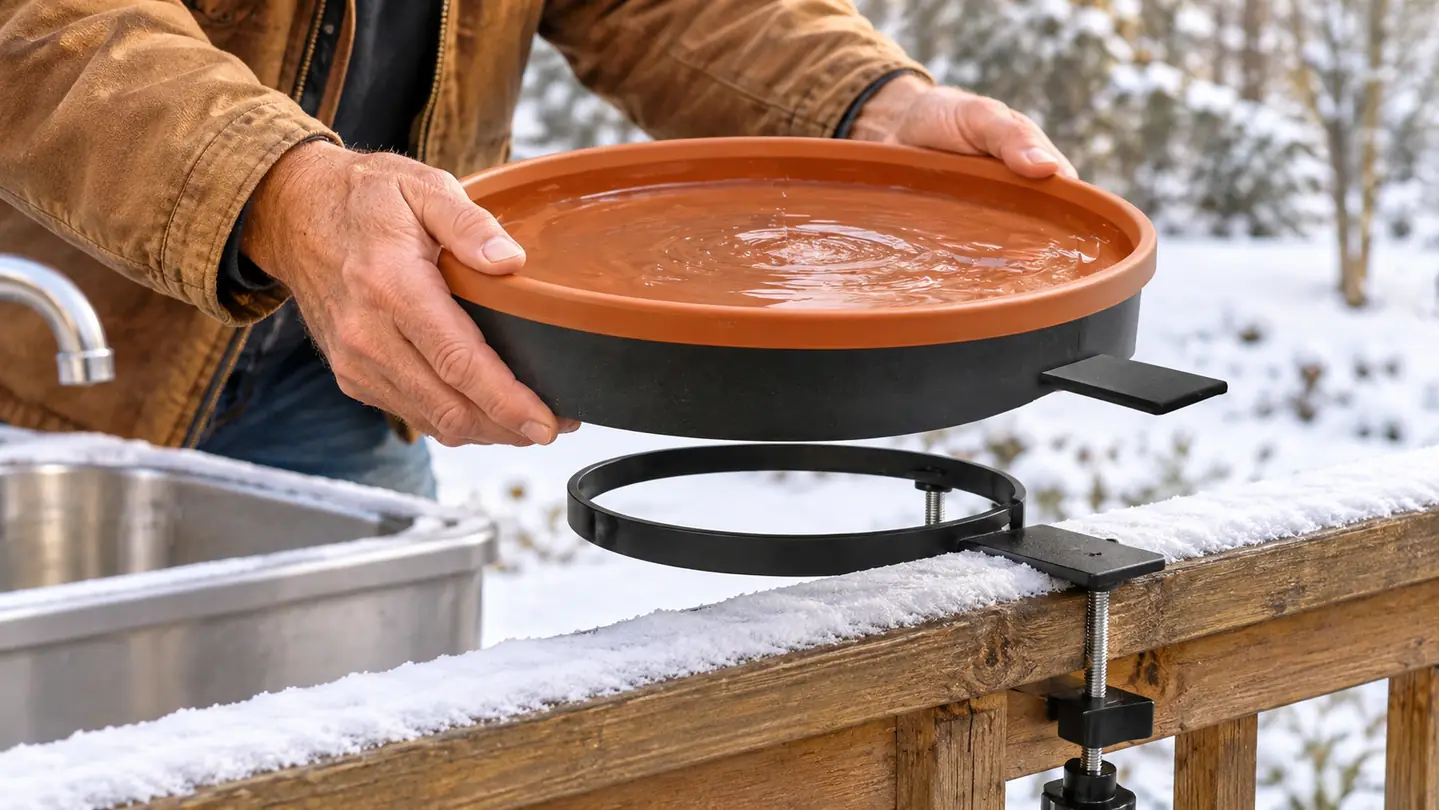
The mounting is the second thing, and it is the reason I stopped borrowing the deicer. The bowl goes on a deck rail with the deck hardware, on a post with the clamp, or on the ground on the legs. Those three EVA gaskets stick on the metal ring so the tray sits level when your rail is not level. My deck rail is not level. It has not been level since Earl backed the truck into it in 2019. That is a small, unglamorous detail, and it is exactly the kind of detail that decides whether a bowl of water stays put in a gust or ends up in the flower bed. And because the bowl is the heater, there is no second cord draped across the patio into a bath that was never designed to hold one. One cord, one plug, and I ran it along the underside of the rail with two plastic clips so it does not whip around when the wind gets up. The whole install took about twenty minutes, most of it spent deciding which rail section to use. I tried the clamp mount on the fence post first. Birds used it fine, but that post is on the far side of the patio and I cannot see it from the sink, and a bird bath you cannot see from the sink is a bird bath you forget to fill.
Weight matters more than I expected, and 5.1 pounds is the number that settles it. My old bath was hollow and light, and a fat squirrel landing on the rim could tip the whole thing. This one, with water in it, does not budge, even up on the rail. The bowl is 13 inches across and 2 inches deep, which is shallow enough that a chickadee can stand on the rim and reach the water without committing to a swim, and wide enough that three birds can crowd it at once without shoving one another off. I watched a cardinal and two house finches share it on a Sunday morning in February, which never once happened with the narrow bath I had before. Pickle, my budgie, has opinions about all of this from his cage in the den, but he is an indoor bird and the outdoor bath is not his business.
Where a Bird Bath Deicer Wins
Here is the honest case for the deicer, and it is a real case. If you own a good bath already, especially a heavy pedestal bath or one set into concrete, a deicer lets you keep using it. There is no assembly, no mounting hardware, no deciding whether the legs go here or the clamp goes there. You set the unit in the water, run the cord, and the water stays open. The one I borrowed was a plain thing, just a sealed housing on a cord that goes in the water, and it did exactly what it promised for the two weeks I had it. I never once found ice on the surface. For a lot of people that is the entire job, and buying a second bowl they did not need would be foolish. I would tell my own sister to go this route if her setup already worked.
A deicer also disappears when the season ends, which matters if you are the one who has to store things. It comes out of the bath, dries on the porch, and hangs out of the way until next December. And it does not care what your bath looks like or how wide it is. If you have a broad, shallow concrete bath that the cardinals already trust, dropping a heater into it changes nothing about the bath they know. That continuity is worth something in a yard where the birds are skittish to begin with. Birds are creatures of habit, and so am I, and neither of us enjoys rearranging the furniture in January. The catch, and it is the reason I did not keep the borrowed one past the two weeks, is that a deicer sits in the water, and water in January is exactly where the mess collects. You are still scrubbing the bath underneath it, and the unit itself wants a wipe now and then or it comes out in March looking like something dredged from the bottom of a pond.
The bowl that is still open water at six in the morning
The GESAIL heated bird bath mounts on a deck rail, a post, or the ground with the hardware in the box, and the cord tucks away when winter is over.
Amazon Check Today's Price on Amazon →What a Cold Morning Actually Looks Like
The morning I keep thinking about was 26 degrees with grass white all the way to the fence. I went out at seven with the jug. The GESAIL bowl had a skim of ice at the very edge where the wind hits it and open water in the middle, and a Carolina wren was already on the rim giving me a piece of her mind for being late. The bath I used to have would have been a hockey puck by then. That is the difference in one sentence. With a deicer in an old bath you get open water too, but you get it in a bath that may or may not be sited well, and mine was sited where the hose reached rather than where the birds wanted it.
I timed the refill once, out of curiosity. Forty seconds with a half gallon jug, and carrying the jug out is the only labor left in the whole routine. Compare that with the saucepan years, when I was making two trips and ruining a good pan with mineral scale. The bowl holds enough that I can skip a day when I am feeling lazy and it is still worth visiting. That is not a scientific measure of anything. It is just the difference between a chore I dread and a thing I do while the coffee is still brewing.
Cleaning is the part nobody talks about. A heated bath stays wet, and wet seed hulls and droppings do not evaporate. The GESAIL bowl lifts off the ring, so I carry it to the utility sink, scrub it with a brush and a little dish soap, rinse it twice, and set it back. Ten minutes, once a week, and Pickle supervises from his cage in the den because he believes any running water is about him. A deicer does not make cleaning easier or harder. You still have to haul the bath itself, and if yours is the heavy pedestal kind, you already know how much you look forward to that particular chore.
At 26 degrees the edge had a skim of ice and the middle was open water, and a wren was already complaining that I was late.

What Neither One Fixes
Neither one keeps a bird from visiting somebody else's yard, and neither one is a substitute for cleaning. Warm water in January is a fine place for bacteria to have a party, so whatever you buy, plan on scrubbing it weekly with soap and water and rinsing it well. A bird bath is also not the place for additives of any kind. Plain water, changed often, is the standard advice, and if you have a question about what is safe for the birds in your area, ask your state wildlife agency or an avian vet rather than me. I am a retired school librarian with a pecan tree.
Neither one solves placement either. A bath out in the open, away from cover, gets used less and freezes faster because the wind reaches it. Mine sits about eight feet from the pecan trunk and about twelve feet from a hedge the chickadees use as a staging area, and it is the second spot I tried. The first spot looked better from the kitchen window and got almost no traffic. So if you buy the GESAIL expecting the yard to reorganize itself around it, budget a week or two of moving it before you settle on a spot.
One more thing neither product will tell you: the water level drops faster in cold, dry air than you expect, and a half empty bowl freezes solid much faster than a full one. I check mine every morning before the coffee finishes and top it off if the wren has been splashing. Two minutes. And if the cord is the thing holding you back, go look at where your nearest outdoor outlet actually is before you order anything, because a bowl with a cord that cannot reach an outlet is a bowl you will not use.
Who Should Buy Which
Buy the GESAIL heated bird bath if you are setting up a winter water source from scratch, if your current bath is cracked or tippy or too shallow to hold heat, or if your bath sits on a deck rail where a stable mount matters more than a big basin. Buy it too if you would rather put out one thing in November than hunt for a bath and a heater separately. The 4.3 star average across 2,060 ratings lines up with my experience: the unit works, and the mounting is the part people either appreciate or find fiddly.
Buy a deicer instead if you already have a bath you love, if it is heavy enough that wind is not a concern, and if your winters are short enough that three or four weeks of ice is the whole problem. That is a perfectly sensible way to run a yard, and I would not talk you out of it. The mistake I made for years was neither of those things. I was carrying hot water out in a saucepan, which is the hardest option once you count your mornings.
One bowl, three mounts, and no more saucepan
The GESAIL heated bird bath with the thermostatically controlled 75 watt element is the one I keep out by the pecan tree from November through March.
Amazon Check Today's Price on Amazon →