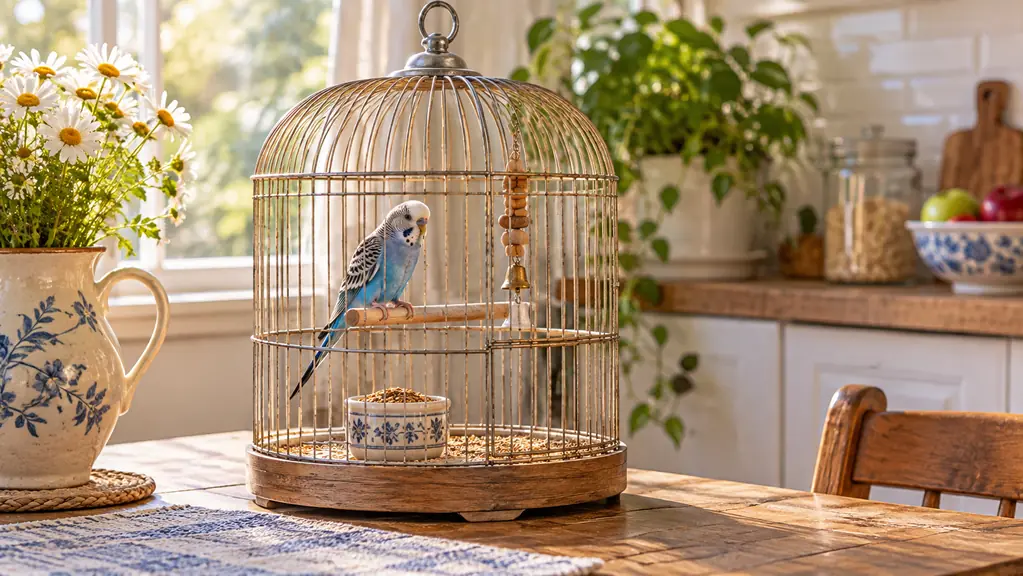
Pickle is six years old, roughly 35 grams, and green and yellow in a way that makes visitors stop at the cage and say something foolish. He is also the reason I spent a whole January reading bird food bags in my kitchen the way I used to read overdue library books. For four years I fed him the same plain seed, one scoop in the morning and one at supper, because that is what came home with him and because he cleaned the dish every single time. It took me an embarrassingly long while to understand that a budgie can empty a dish and still be missing things.
Here is what the pet store does not say out loud. Most parakeet seed mixes lean heavy on the small sweet seeds because birds love them, and budgies are champion shoppers. They push the pieces they want to the rim, eat those, and leave the rest sitting there like last week's lima beans. So you can fill a bowl twice a day and still be running a very narrow diet. That is the problem a fortified food like Kaytee Forti-Diet Pro Health is built to solve, and it is only half the job. The other half is getting the bird to actually eat it, which is where most of us give up. One thing before we start: I am not a veterinarian and I do not play one on the internet. If your bird is fluffed up, sitting low on the perch, or losing weight, that is a vet call, not a food change. Make it today.
Four years of plain seed, and the fix was a bag I could have bought in year one
Kaytee Forti-Diet Pro Health for parakeets mixes variety seed with fortified chunks and superfoods including flaxseed, peanuts, blueberries and spinach. Antioxidants and omega-3s do the work on brain and heart support, and the 4 pound bag lasts me about two months with one small bird.
Amazon Check today's price on Amazon →Why the Slow Switch Beats the Clean Sweep
The temptation is to dump the old food in the trash and fill the dish with the good stuff. I did exactly that one February, and Pickle looked at the dish, looked at me, and went to the far perch with his back turned like a man who had been insulted at a restaurant. He flung pieces out onto the grate. He would not touch it. By evening I was the one sweating, not him.
Budgies are cautious about new things by nature. In the wild, a strange food is a question mark, and a bird that eats the wrong question mark does not get to be six years old. So the goal is not to win an argument. The goal is to make the new food boring and familiar, which is the same method I used for thirty years to get children to read chapter books. You put it in front of them next to something they already trust, and you do it again tomorrow. Never let a budgie go a full day without eating. If yours refuses completely, back up a step rather than push through.
Step 1: Write down what he eats now
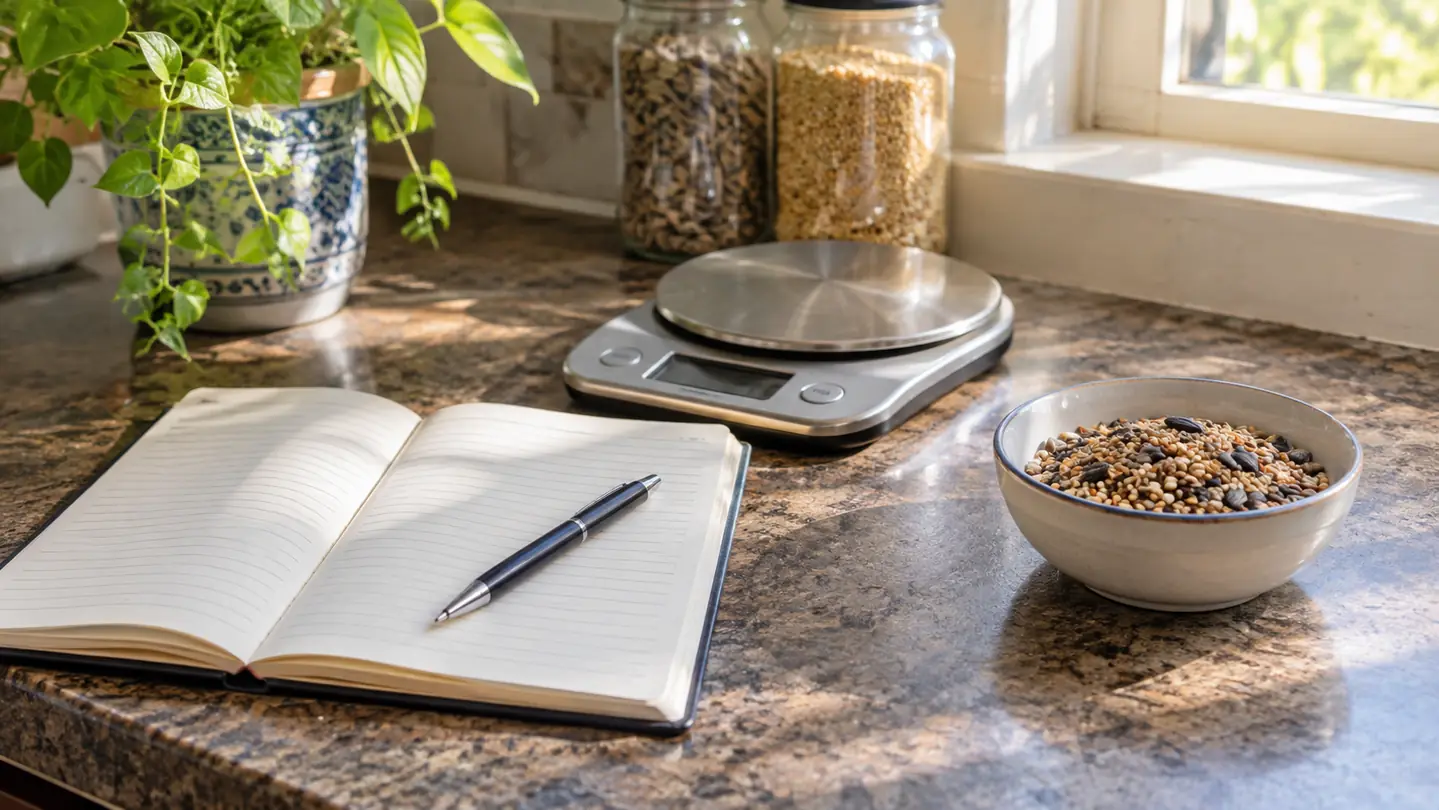
For three days, keep a small notebook on the counter and jot down what goes in the dish and what is left at the end of the day. Note the brand, the scoop size, and whether the dish is empty or half full. This sounds like busywork. It is not. By day three you will see the pattern, and the pattern is usually that your bird has been eating about three things out of the twelve in the bag. I found out Pickle had not touched a single round seed in years. He had been flicking them onto the floor and I had been sweeping them up and blaming the cat.
Then get a number. A small digital kitchen scale, the same one I use for flour, will weigh a budgie in grams if you set a small dish on it and let the bird step on. Pickle sits at about 35 grams, and I weigh him every Sunday morning before breakfast so the number means something. Write that baseline on the first page. It is the only honest way to know whether a food change is going well or going sideways.
Step 2: Set a ratio you can actually keep straight
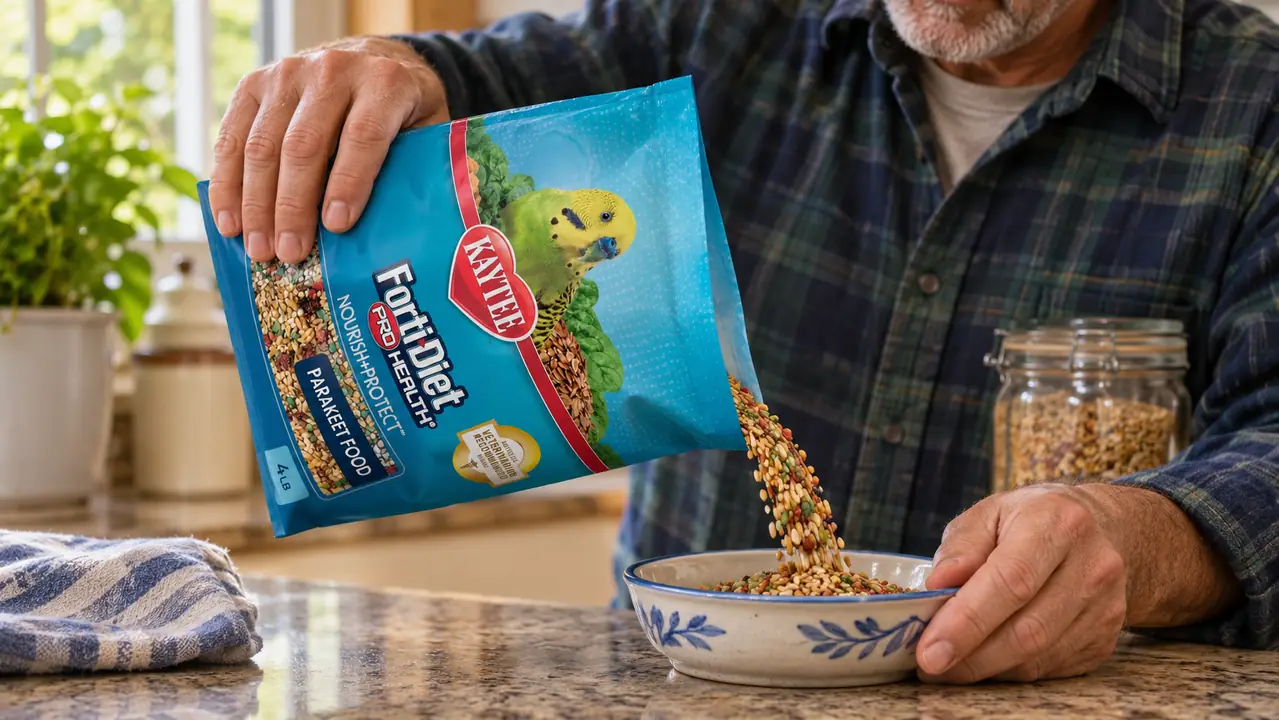
Start at four parts old food to one part Kaytee Forti-Diet Pro Health. Measure it with a measuring spoon, not by eye, because by eye becomes whatever mood you are in that morning. Put a strip of masking tape on the bag and write the ratio on it. When you change the ratio, change the tape. I have a whole row of crossed-out numbers on mine and it tells the story better than any diary.
The reason for a ratio instead of a clean swap is simple. Your bird is going to eat the familiar pieces first, and the small amount of new food rides along with them. Taste happens by accident. A budgie that picks up a chunk of fortified food while hunting for a favorite seed has just learned that the chunk is not poison, and that lesson is worth more than any amount of coaxing.
What is in that new portion matters too. The Kaytee mix brings in flaxseed, peanuts, blueberries and spinach along with the seed, and the fortified chunks carry the vitamins your bird was not getting from a bowl of small sweet seeds. Antioxidants and omega-3s are listed for brain and heart support, and the label also names skin, feather and immune support. I am not going to tell you it will fix a sick bird. It is food. But it is a wider net than what Pickle was eating before.
Step 3: Same time, same dish, same corner of the cage
Birds eat on routine the way some of us drink coffee on routine. Serve at the same hour each morning, put the dish in the same spot, and take the fresh food out after a few hours so nothing spoils in the warmth. Fresh water goes in at the same time. Pickle knows the sound of the dish before he sees it, and that small bit of predictability makes him bolder about what is inside it.
Use one dish, not two. I know the advice out there says offer a separate dish of the new food, but with a budgie that just means he eats from the old dish and treats the second one as furniture. One dish forces the introduction. It also means you have to be patient, because for the first week he will do a lot of staring.
Then sit down. Pull a chair up and talk to him or read the mail out loud. A nervous bird will not try new food, and a bird with a person nearby settles faster than one left in a quiet room. Some mornings I read him the grocery list. He seems to prefer it to the news.
Step 4: Read the leftovers, not the bird's face
A budgie's expression will tell you nothing. The dish tells you everything. Look at what is left after a few hours. If the chunks are still there and pushed to the rim, he is sorting. If the dish has empty hulls in it, he is eating. If the new portion is gone but the old food is untouched, he has surprised you and you can move faster than planned. Write down what you see each day. Two lines is enough.
Hold each ratio for about a week to ten days before you move it. Then shift by one part, so four to one becomes three to one, and hold again. That is slower than most people expect, and it is the entire method. My own switch from plain seed to a full dish of Kaytee took five weeks, which felt endless at the time and looks like nothing in the rearview mirror.
Watch the scale while you do this. A steady weight is the green light. A drop of a gram or two in a small bird is worth a call to your avian vet, not a wait and see. Also watch the droppings and the noise level. A budgie that goes quiet and stops chattering in the morning is telling you something, and it is not about the food being bad.
Five weeks, one part at a time, and the only thing that changed fast was the notebook. Pickle now eats the whole dish, chunks included, and he has never once looked grateful about it.
Step 5: Move the ratio, then hold the line
Once you reach an even split and the dish is coming back empty, go to one part old food and three parts Kaytee for a week, then drop the old food entirely. Expect one sulky day. Pickle spent his sulk walking along the dish rim and giving me a look I can only describe as disappointed. By the next morning he was eating. That is the usual shape of it. If your bird goes more than a day refusing food, back up a step and hold longer.
Then do nothing. This is the part that matters and the part I got wrong the first time, because a week later I felt sorry for him and stirred a handful of the old seed back in. He picked it out in an hour and we lost two weeks. Hold the new food steady for at least a month before you change anything else in the cage.
Keep the bag sealed and stored somewhere cool and dry, not in the garage where the humidity gets to it in a North Carolina summer. The 4 pound bag is the right size for one budgie in my house, roughly two months of food, and it is small enough that it does not sit around going stale. I write the date I open it on the clip.
What Else Helps
Food is one lever, not the whole machine. Fresh water twice a day, a cuttlebone in the cage, and a few hours of daylight on a regular schedule all do quiet work. So does foraging. I scatter a pinch of the Kaytee mix in a shallow dish with a couple of clean paper squares over it and let Pickle dig, which takes him ten minutes instead of ten seconds and gives him something to do besides supervise me. A bird with a job is a calmer bird, and a calmer bird tries new food faster.
Keep the weekly weigh-in going even after the switch is done, because weight is the earliest signal you will get and it costs you thirty seconds. And find an avian vet before you need one. Ask them about your bird's diet at a well visit and let them tell you what they want to see. Mine was kind about the four years of plain seed and did not make me feel like a fool, which I appreciated. If anything about your bird's health worries you, that is their department, not mine and not a bag of food.
Slow is the whole trick, and the bag is the easy part
Kaytee Forti-Diet Pro Health for parakeets comes in a 4 pound bag with variety seed, fortified chunks, and superfoods like flaxseed, peanuts, blueberries and spinach. Buy the bag. Then give it five boring weeks and a notebook.
Amazon See today's price on Amazon →