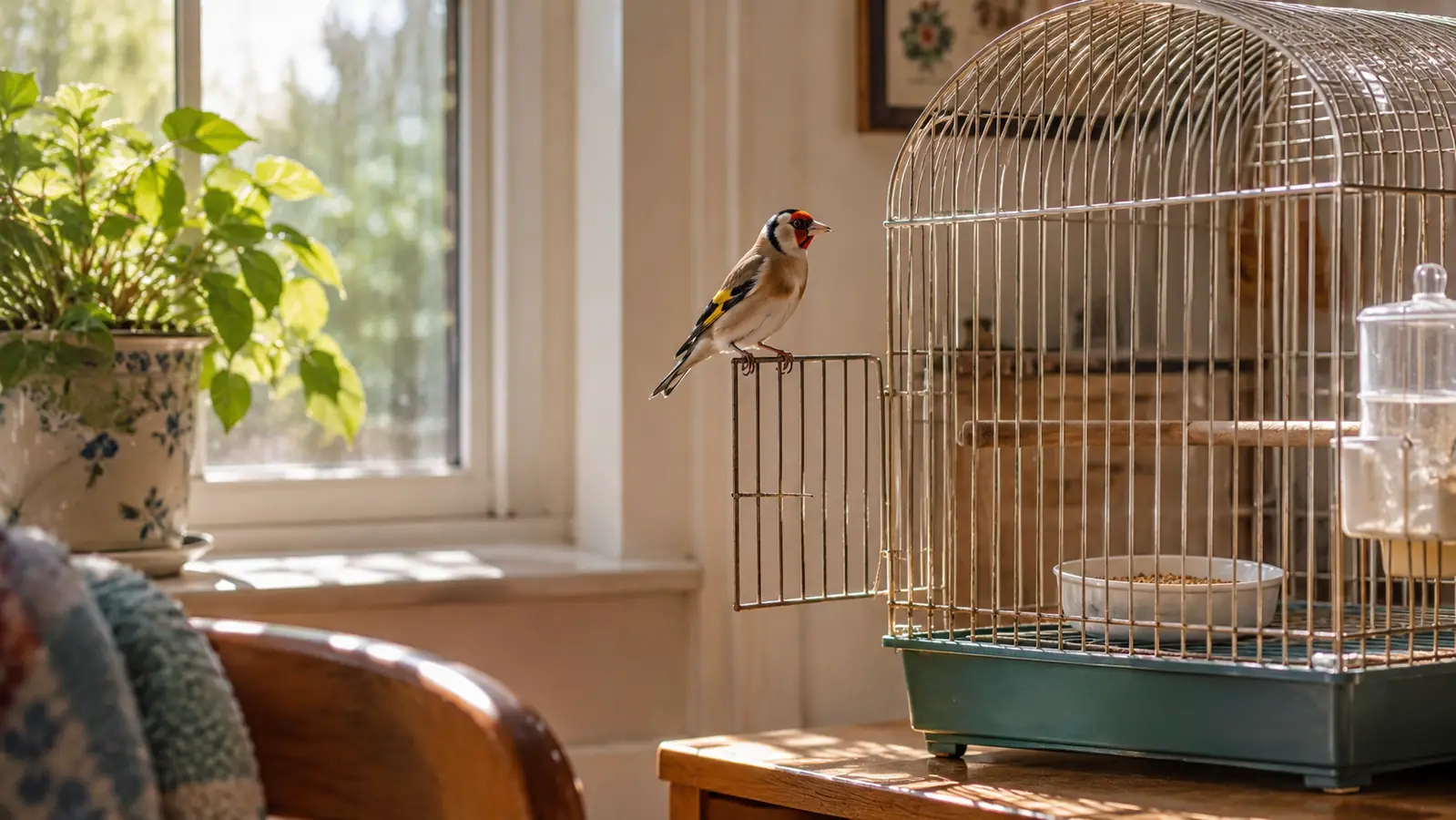
Pickle is six years old, weighs about 35 grams, and treats anything new in his cage like a personal insult. So when I moved him onto Kaytee Forti-Diet Pro Health, I did it the slow way. Ten days of mixing a spoonful into his old seed, watching what he ate and what he swept onto the floor with his beak. That is the honest start of this review, because the first week told me almost nothing and the third week told me plenty.
I am not a vet and I am not going to write like one. I am a retired school librarian in a one story brick house outside Greenville, North Carolina, with one budgie, a husband named Earl, and a kitchen drawer full of receipts. What I can tell you is what changed in the cage over roughly four months of daily use, what still irritates me, and who ought to walk right past this bag and buy something else. The glowing reviews cover the pleasant part. This is the rest of it.
The Quick Verdict
A dependable parakeet seed mix with real added nutrients and a fair amount of dust and hull mess. Honest value for one or two small birds, but it is not a cure for a picky eater and it is not a pellet diet.
Amazon Check Today's Price →The bag I keep reordering even with the mess
Four pounds lasts a single budgie just under two months in my house. Check the current price before you decide between the four pound bag and the larger size.
Amazon Check Today's Price on Amazon →The First Thing Nobody Tells You
It is a seed mix. That sounds obvious until you read the listings, which carry on about superfoods and brain function and immune support until you could be forgiven for thinking you are buying a pellet. It is not a pellet. Kaytee Forti-Diet Pro Health is a variety seed blend with flaxseed, peanuts, blueberries and spinach worked into it, along with the antioxidants and omega-3s the bag promises. For a budgie who has eaten seed his whole life, that is a reasonable thing to put in a dish. For a bird that needs a complete formulated diet, it is not the whole answer, and no bag of seed is.
Here is the part I did not expect. Pickle ate the peanuts first. Then the seed. The blueberry pieces and the spinach bits sat in the dish for four days while I worked myself up to complaining about it, and then he decided they were not poison after all and started eating them. That is budgie behavior, not a product flaw, but it matters. If your bird picks out the good parts and leaves the rest, you are paying for nutrients that end up on the cage floor, and no amount of reading the front of the bag changes that.
Before I settled on the twice a day routine, I tried the other direction. I put a small dish of pellets in the cage and left the seed out entirely for a morning, on the theory that a hungry bird will eat what is in front of him. Pickle sat on his perch and screamed at the dish for two hours, then went and sulked in the corner with his feathers fluffed. I gave in before lunch. That was in late March and I still feel a little silly about it. Budgies are stubborn in a way that is almost admirable, and a standoff over food is a standoff you will lose.
So I stopped free feeding. Half a portion in the morning, half in the late afternoon, and nothing added back until the dish is mostly empty. That fixed it inside a week. I still keep a small dish of fresh greens and a few pellets available, on the advice of the avian vet we see twice a year, and I would tell anyone with a bird to do the same. One bag of anything is not a feeding plan. It is one piece of one.
How I've Used It In a One Bird House
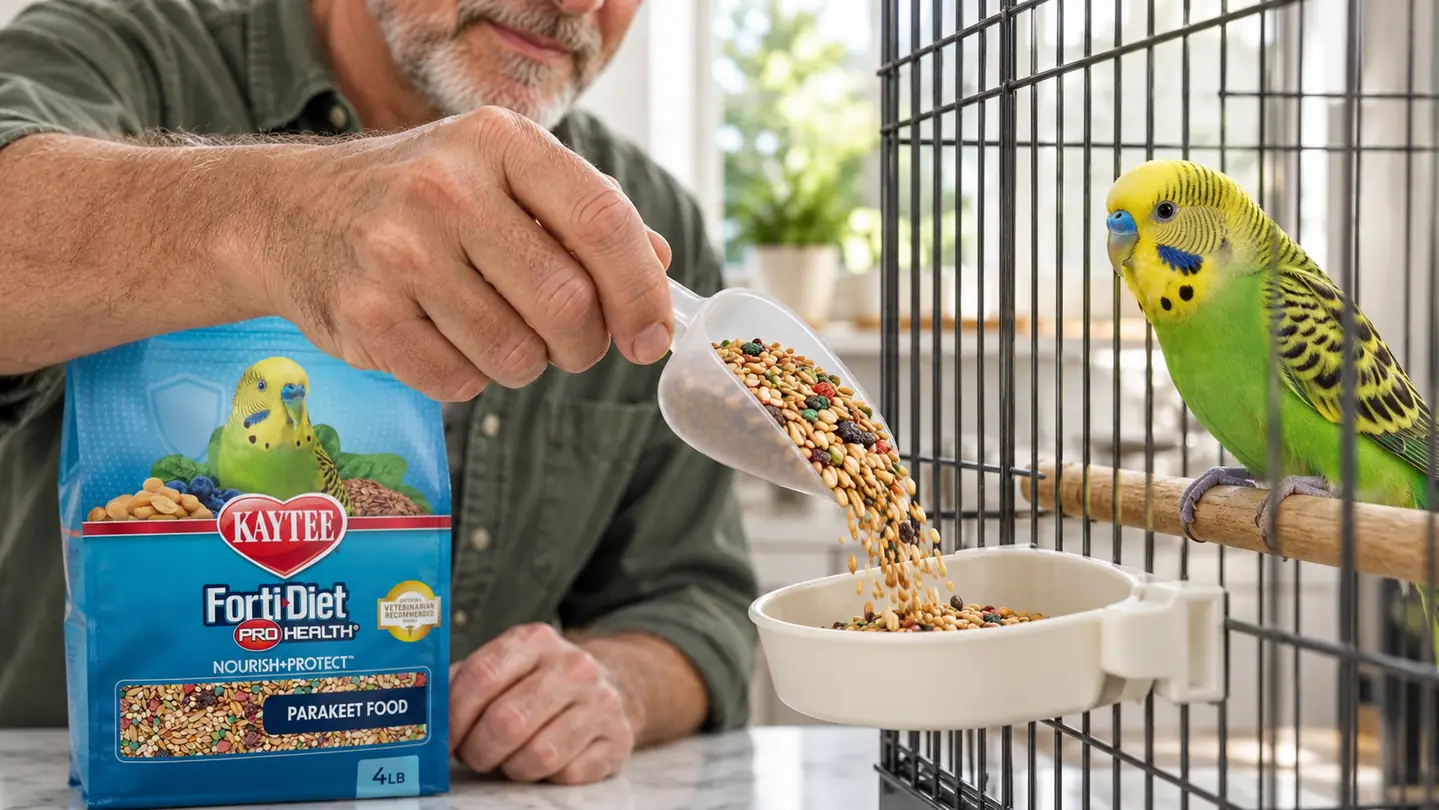
The bag is four pounds and measures about 4.5 by 8.5 by 11 inches, which is bigger than it sounds when you are standing in the kitchen holding a scoop. For one 35 gram budgie, four pounds works out to just under two months. I empty it into a plastic tub in the hall closet and fold the bag over inside that, because a four pound bag of seed does go stale if it sits open in a warm kitchen all summer. Nothing clever. A tub with a lid that actually closes.
The tub lives on the second shelf of the hall closet, which stays cool even in a Greenville July, and I keep a one cup scoop inside it so I am not digging in with my hand. I write the date I opened the bag on a strip of masking tape on the lid. That is a librarian habit and it has saved me twice, because a bag that has been open since April smells flat by July and I would not have noticed without the note. Four months in, I have never had a batch go moldy, but I have had one go dull, and I dumped the last two cups rather than feed it to him.
The dish is a shallow ceramic one clipped inside the cage, and I fill it about a third full. Pickle is a floor forager by nature, so a good share of what he eats he eats off the grate. That is worth knowing before you decide the food is being wasted. Some of it is. The rest is just being eaten at a lower altitude, and I have made my peace with it.
I moved him over about ten days, starting at roughly a quarter new food to three quarters old, then half and half, then mostly new. No loose droppings, no fluffed up sitting in the corner, no drama. Pickle is suspicious of new objects but he is not suspicious of new food, and I know that is not true for every bird. If yours treats anything unfamiliar in the dish as a threat, stretch the switch to two weeks and do not rush it because you are impatient.
The Good: What Actually Changed
By the end of the third week, the difference I could actually see was in his feathers. Pickle has always had a slightly rough patch at the back of his neck where he cannot reach, and it looked smoother and less dry. I am not going to tell you a seed mix cured anything. I am telling you what I saw in my own kitchen, and the omega-3s listed on the bag are exactly the sort of thing that gets credited for feather condition. It also could have been the weather. I am reporting, not diagnosing.
The second change was noise. He is a morning bird anyway, but by week four he was talking earlier, louder, and with more variety, including a whistle he picked up from the microwave timer. More energy in a six year old budgie is either the food or the longer days, and I cannot prove which. What I can prove is his weight. He has stayed steady at about 35 grams on the kitchen scale, and for an older bird that number matters more than anything printed on a bag.
I keep a small notebook in the kitchen drawer with his weights in it, because the vet asked me to years ago and I never stopped. The entries run 34.8, 35.1, 35.0, 34.9 through the spring, which is the kind of flat line you want. The only dip was a 34.2 in early June, the week the air conditioning went out and the whole house was miserable, and he was back to 35 by the following Monday. I am not attributing any of that to Kaytee. I am saying that a food change that keeps the number steady for four months is a food change I stop worrying about.
The third thing is boring, and it is the reason I keep buying it. The droppings stayed normal. No loose days, no changes that worried me, no rushed call to the vet. When you change a bird's food, that is the test you are running for the first month, and this one passed it. A four pound bag also lasts long enough that I am not running to the store every three weeks, and for a single bird that is most of the value right there.
Twelve days in, the dish was empty every morning and the cage floor was not. For a picky budgie, that is the whole review.
The Not So Good: What Nobody Mentions
The dust. Good grief, the dust. Every bag of seed has some, and this one has a visible cloud at the bottom of the bag and a fine powder that settles on the dish, the grate and the wall behind the cage. I have started pouring outdoors on the patio, which Earl finds hilarious right up until he is the one holding the broom. If anybody in your house has breathing trouble, pour it outside, keep the tub sealed, and do not shake the bag over the sink.
The wall behind the cage is where it shows worst. It is a pale yellow, and by the end of April there was a faint gray haze on it at exactly the height of the cage, which I did not notice until the afternoon sun came through the window at the right angle. A damp cloth took it off in about two minutes. I now do that wall and the grate every Sunday morning while Earl reads the paper, and I have stopped resenting it, mostly. If your cage sits against a light colored wall in a room with good afternoon light, expect the same and plan for the cloth.
The peanuts are big. The bag lists peanuts, and what that means in a dish is pieces a 35 gram budgie has to work at. Pickle manages, but he drops a good many fragments, and I have found peanut chunks in the grate a day later. If you keep a smaller bird, or a bird with a beak problem, break them up with the back of a spoon before the dish goes into the cage. It takes ten seconds and saves a lot of sweeping.
The bag itself is floppy and awkward once it is half empty. There is nothing wrong with it, exactly, but it will not stand up on the counter and it will not stay folded neatly, so you end up with seed in the crease and a bag that tips over at the worst moment. This is a small complaint and I know it. I also know that after four months of it I went out and bought a tub with a lid, and I would buy the tub on day one next time.
Last one, and this is the honest one. Not every bird is going to eat the fancy parts. If yours sorts through the dish and eats only the seed, you are paying for flaxseed and blueberries that go in the trash. Watch the dish for a week before you decide this is a good deal for your bird. A neighbor of mine has three birds. Two eat it fine. The third eats around anything green, and she went back to what she was using before, which was the right call for her flock.
What the Label Tells You and What It Does Not
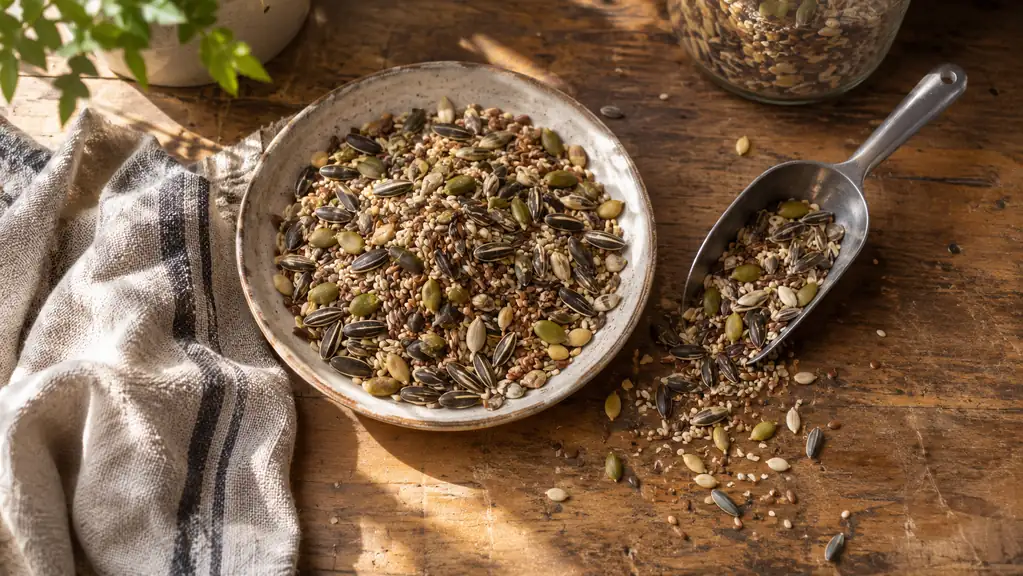
The bag is specific about what goes in. Flaxseed, peanuts, blueberries, spinach, soybean meal, and the antioxidants and omega-3s that come with them. It lists brain health, heart health, skin and feather health, immune support, digestion and visual health as intended uses, and Kaytee has been making animal food for over 150 years, which is either reassuring or simply a long time, depending on your mood that day.
What it does not tell you is how much of your bird's daily nutrition is actually coming from those extras. A seed mix is a seed mix, even a well made one. If your bird needs a particular ratio because of a liver issue, a hormone problem or a diagnosis from your vet, this bag is not going to solve it and you should not try to make it. Ask your avian vet for a diet plan and use this as one piece of it, not the whole thing.
That is also the fair way to compare it against something like Wild Harvest Daily Blend. Both are seed blends. Both have extras stirred in. The real difference shows up in what your bird actually eats, not in what is printed on the front of the package. I have poured both into the same dish on different weeks and simply watched, and that told me more than either label did. Your bird will give you the answer in about nine days if you pay attention.
What I Liked
- Pickle actually eats it, including most of the added pieces after a slow switch
- The rough patch at the back of his neck looked noticeably smoother by week three
- Droppings stayed normal through the transition and for months afterward
- A four pound bag lasts a single budgie just under two months
- One bag covers the everyday feeding job without a second trip to the store
Where It Falls Short
- Noticeable dust at the bottom of the bag and a fine powder around the cage
- Peanut pieces are large for a small bird and a lot get dropped
- The bag will not stand up or stay folded neatly once it is half empty
- A bird that sorts out the extras wastes the nutrients you paid for
- Not a pellet, so it cannot be the whole diet on its own
Who This Is For
This is for the person with one or two parakeets, a bird that already eats seed, and no interest in fighting a pellet conversion this month. It suits a household that can store four pounds in a sealed tub and pour it outdoors on a breezy morning. It suits a bird like Pickle: six years old, steady weight, no diagnoses, needing a dependable everyday mix with a little more in it than the plain grocery store bag. It also works fine as the seed half of a mixed diet, provided your vet has signed off on the other half.
Who Should Skip It
Skip it if your bird has been put on a specific diet by an avian vet, because no bag of seed should override a professional. Skip it if your bird is a confirmed sorter who leaves everything but the seed, since you are paying for spinach he will never touch. Skip it if you keep a large flock where four pounds goes stale before it is eaten, or if someone in the house has a dust sensitivity that a seed bag will set off. And skip it if what you actually want is a pellet. This is not a pellet. It never claimed to be, and buying it hoping otherwise is how people end up writing furious reviews of a product that did exactly what it said on the bag.
If your bird already eats seed, this is the bag to try next
Switch over ten days, pour it outside, keep it in a tub with a lid. That is the whole method. Check today's price on the four pound bag.
Amazon Check Today's Price on Amazon →