
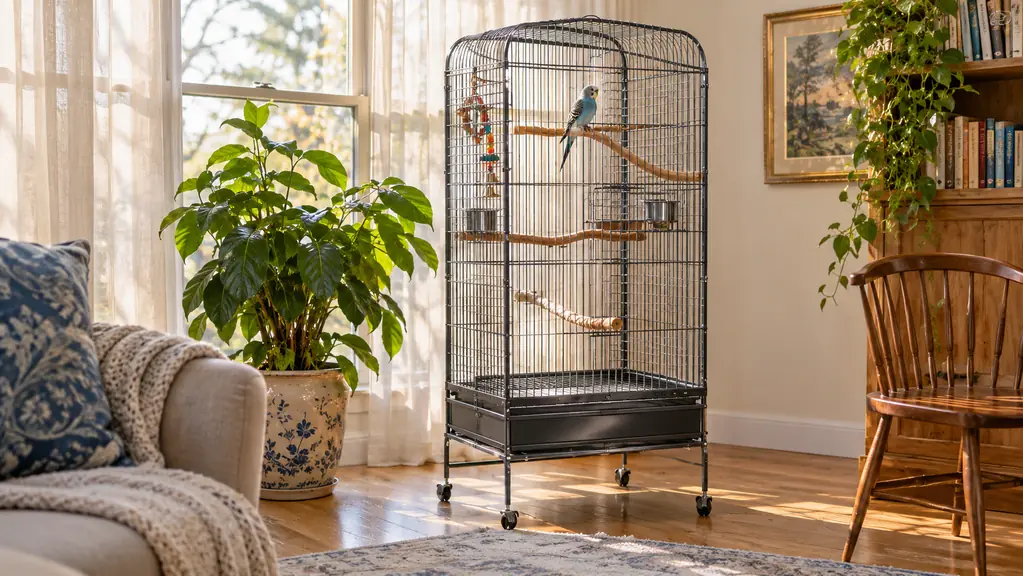
Pickle has lived with us for six years, and for the first five of those he lived in a tabletop cage that I now think of as a box with a guilt problem. It sat on a side table by the kitchen window. He could turn around, hop to the food dish, and that was the whole tour. Last spring I bought a flight cage, the Prevue Pet Products Steel Bird Flight Cage with Wheels in the large size, and the change in that bird was almost immediate. He climbs now. He hangs upside down from the roof like he is showing off for company.
I am not going to tell you a cage fixes everything, because it does not. What I will tell you is that a flight cage is the one piece of bird equipment where the upgrade shows up in the first week, and this one measures 31 inches long, 20.5 inches wide and 53 inches tall. That is a different animal from the starter cages most of us buy first. Here are ten plain reasons it earns the floor space. Then I will tell you a few things I would skip. I keep the receipt in the kitchen drawer with all the others.
A cage tall enough that the bird has somewhere to go
The Prevue Pet Products Steel Bird Flight Cage measures 31 by 20.5 by 53 inches, with half inch bar spacing, four feeders, two doors and a removable tray. It rolls, which matters more than you would think at 19 pounds.
Amazon Check Today's Price on Amazon →Budgies climb more than they walk
Parakeets are built for going up. In the old cage Pickle had about a foot of height, so his climbing was really just turning around. The flight cage gives him 53 inches of it, and he spends most of his waking day in the top third. Watch a budgie in a low cage and you can see the ceiling stopping him. That is what you are paying for here. Not floor space. Height.
Half inch bar spacing is the right size for a budgie
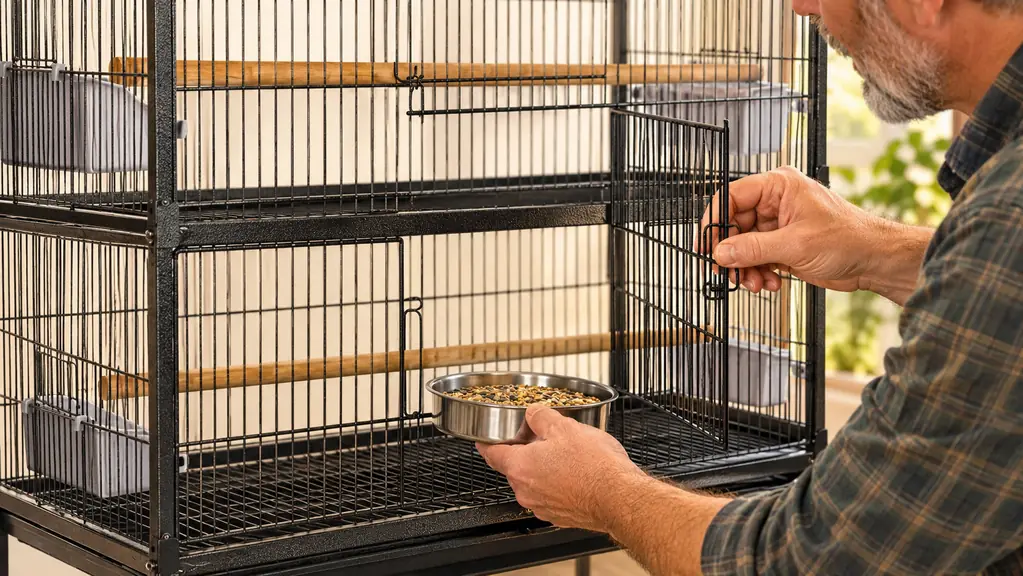
The bars on this cage are half an inch apart, and that number matters more than the trim or the shape of the roof. Bar spacing is the one measurement that decides whether your bird stays inside. Wide spacing is where small birds get heads caught. If you keep something smaller than a budgie, ask an avian vet before you buy anything, because I am a retired librarian and I am not going to guess at your bird. For a budgie, half an inch is the number I looked for.
Four feeders means one less chore every morning
The cage comes with four feeders, and I use all four, two for seed and two for water. That means I am not washing and refilling one dish twice a day. Pickle is a morning talker and a morning eater, and the first hour is the busy one in this house. Spread out dishes also mean he moves between them instead of parking in one spot. Small thing. You notice it every day, twice a day, which is how small things become big ones.
Two doors, so your arm is not the barricade
There are two doors. That sounds like a specification until you have tried to change a water dish through a single door with a bird sitting on your wrist. With two, I open the one on the far side, reach in, and Pickle stays where he is instead of deciding my hand is the most interesting thing in the room. If a budgie has ever made a break for it while you were elbow deep in a food dish, you know exactly what I am describing.
The tray lifts out and goes to the sink
The bottom tray is removable, and that is the feature I would fight hardest to keep. I carry it to the kitchen sink, rinse it, dry it, put it back. Four minutes, once a week, plus a spot clean in between. The alternative is wiping a fixed floor through a door with a rag, which is how cages end up cleaned less often than they should be. A cage you can clean quickly is a cage that stays clean, and that is better for the bird than any fancy perch.
Floor space is what the cage takes from your room. Height is what the bird gets to use. Fifty three inches of the second one is the whole argument.

Wheels, because 19 pounds gets old fast
The cage weighs 19 pounds and it has wheels, so I can move it. It goes closer to the window in the morning and back out of the draft at night, and it rolls aside when the floor needs a real mop. Earl is the one who lifts things around this house. I am the one who has learned not to ask him to lift a cage that could have been rolled. You will not think about the wheels again, which is the highest compliment you can pay a wheel.
Three levels, so he has somewhere to go that is not where he sleeps
The cage has three levels, and Pickle assigned himself: sleep up top, food in the middle, the bottom for the business of being a bird. I did not plan that. He did. The point is that a bird with levels has choices, and choices cut down on the pacing you see in a small cage. If your bird spends the day on one perch staring at you, that is not contentment. That is a bird with nowhere to go.
Side doors let you reach the corners
There are small doors on each side, meant for reaching tight areas or attaching an external nest box. I am not breeding budgies and I am not going to start, so the nest box part is wasted on me. The reaching part is not. The far corners are where the food ends up after Pickle has flung it, and getting a hand in from the side instead of folding myself around the front door is a mercy I use weekly.
Steel frame, and a warranty that tells you something
The frame is steel and the cage carries a 90 day warranty. Ninety days is not a long time and I am not going to pretend it is. What it tells you is that the company is standing behind the welds and the hardware for a season of daily use. We are past that window now and nothing has loosened. The bars are still even, the doors still latch, the tray still slides. Not much drama in a cage that holds up, which is exactly what you want.
It is sized for a small flock, so it does not need replacing
The listing for the Prevue Pet Products cage calls it roomy enough for small bird flocks, and I can see why. Even with one budgie in it, the footprint is 31 by 20.5 inches, which leaves room for a sensible perch arrangement and a couple of toys without turning the place into an obstacle course. A starter cage gets replaced. This one does not, and buying once instead of twice is the most practical argument I can make for anything.
What I'd Skip
Skip the tabletop starter cage if you can go straight to the real thing. I did not, and I spent five years watching a bird with nowhere to climb before buying the flight cage anyway. Going small first is not saving money. It is delaying the purchase you were always going to make, and the bird pays the interest on the delay.
I would also skip anything with bar spacing wider than half an inch for a budgie, skip cages chosen on floor area alone, and skip filling the whole cage with toys on day one. Pickle is picky about new things, and a cage crowded with unfamiliar objects put him in one corner for two days. I add one thing at a time now. And if your bird is showing any sign of illness, that is an avian vet question, not a cage question.
Give the bird 53 inches instead of a foot
The Prevue Pet Products Steel Bird Flight Cage brings half inch bar spacing, four feeders, two doors, three levels and a tray that lifts out. The old tabletop box can go to the garage.
Amazon Check Today's Price on Amazon →