
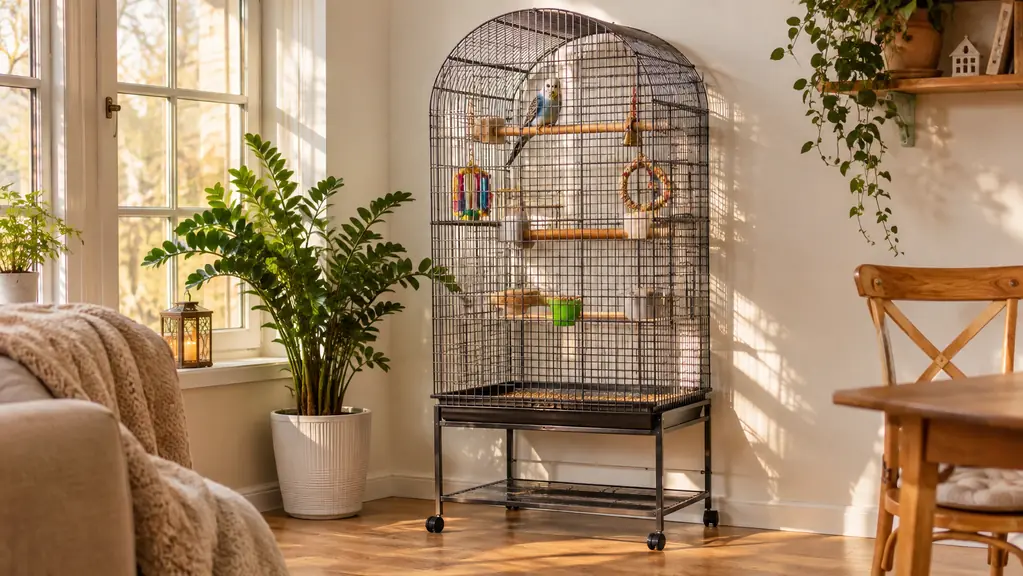
There is a short answer, so here it is first. If your budgie spends real hours inside the cage, the Prevue Pet Products Steel Bird Flight Cage with Wheels is worth giving up a corner of the room for. If the cage is mainly where the bird sleeps and eats while it rides your shoulder the rest of the day, a standard small cage is enough, and it is still the right thing to keep for travel and for the first week with a new bird. I have both in my house right now, for two different jobs, and that is the honest version of this comparison.
My budgie is Pickle, a 6-year-old male, about 35 grams, green and yellow, chatty until roughly nine in the morning and suspicious of anything new after that. He came home in a tabletop cage, the kind most budgies come home in. It was fine. It was also the reason he spent most of his day on top of it instead of inside it, and after a few months of watching him pace the same two perches, I started measuring the corner of the living room. That measurement is what this whole comparison comes down to.
| Prevue Flight Cage | A Standard Small Cage | |
|---|---|---|
| Floor space | 31 inches long and 20.5 inches wide, so a budgie crosses it in a few wingbeats instead of one hop. | Roughly half that footprint, sized to sit on a dresser or a side table. |
| Height and levels | 53 inches tall with 3 levels, which lets you put perches and feeders at genuinely different heights. | Usually one level with two perches at the same height, so there is little reason for the bird to move. |
| Doors and access | 2 front doors plus nest box doors on each side, so the far corners are reachable without contorting your arm. | One door in the middle of the front panel. The back corners are a reach, and the bird learns that fast. |
| Feeders included | 4 feeders come with it, and the side doors let you swap cups from outside the cage. | Two clip on plastic cups, and you reach past the bird to refill them, which is exactly when they decide to sit on the cup. |
| Bar spacing | 1/2 inch, the usual safe spacing for a budgie, with the gap size stated on the listing. | Also 1/2 inch on most starter cages, so this is a genuine tie rather than a point scored. |
| Cleaning | Removable tray, but there is a lot of cage around that tray, and 19 pounds to shift if you want to sweep underneath. | Removable tray as well, and a fraction of the surface area to wipe, so the weekly job takes less time. |
| Moving it | It has wheels, which helps, but at 19 pounds and 53 inches tall it mostly stays where you park it. | You lift it with one hand and set it on the counter while you clean, then put it back. |
| Where it can live | Needs floor space against a wall, away from drafts, the kitchen and the front door. | Fits on a dresser, a bookcase top or a countertop, which matters in a small house. |
| Cost to start | The larger purchase of the two, and you will want perches and dishes to go with it. | Less upfront, which is the main reason it is the cage nearly every budgie comes home in. |
| Warranty | 90 days stated on the listing. | Often not stated at all on budget starter cages. |
| Best for | A single active budgie that spends real time inside, and a household that will be in the same room with it. | Travel, a hospital cage, and the first week or two with a new bird while you decide on something larger. |
Where the Prevue Flight Cage Wins
It wins on distance, and distance is what a budgie actually needs. Thirty one inches of length means the bird can launch from one end, flap three or four times, and land on a perch at the other end. That is not a trick. That is the difference between a bird that moves and a bird that waits. The 20.5 inch depth gives you room to stagger perches front to back so nothing sits directly under anything else, and the 53 inch height with 3 levels lets you offer a high perch for watching and a low one for sleeping without putting them in the same lane.
I measured before I ordered, which is how I know the 31 inch figure is the outside of the frame and not the open space inside it. Once the end panels and the tray lip are counted, the usable run is a couple of inches shorter. I would rather you hear that from me than find it out with a tape measure on setup day. Even so, it is the longest cage that would go in that corner without blocking the window, and I tried two shorter ones first.
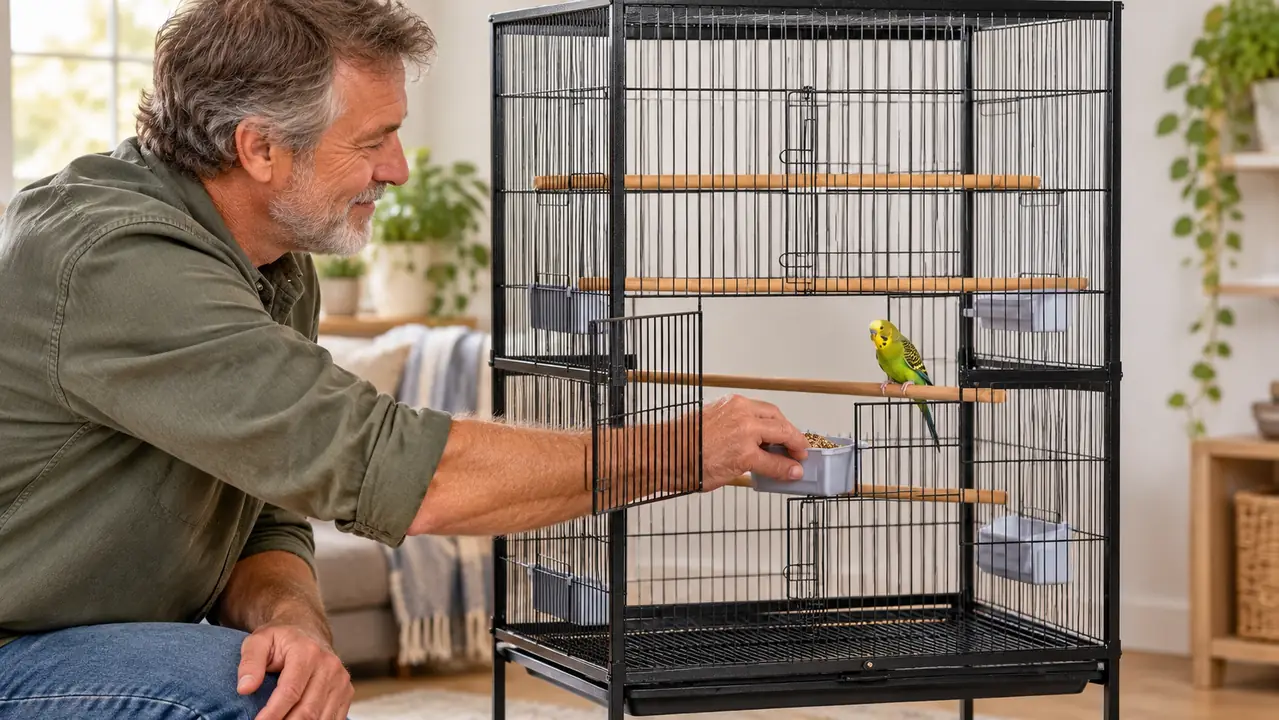
It also wins on access, and this is the part nobody mentions in the photos. Two front doors plus nest box doors on each side means you can reach the back corner, refill a feeder from outside the cage, and attach something to the far wall without opening the whole front and inviting the bird out. The 4 feeders that come with it can be rotated, so one can be soaking in the sink while three are in service. On a small cage with two clip on cups, one dirty cup means the bird eats from a bare spot until you finish washing. The Prevue Pet Products cage is simply easier to run on a Tuesday.
Where a Standard Small Cage Wins
It wins on floor space, and that is not a small thing. A tabletop cage goes on a dresser, a bookcase, the counter by the window, or a corner of a room that has no corner left. In a small house, or a house with a spouse who has opinions about furniture, that matters more than an extra ten inches of flight room. It also costs less to start, which is why it is the cage nearly every budgie comes home in. If your bird is out on your shoulder or on a play stand from breakfast to supper, the cage is a bedroom and a dining room, not a house. A bedroom does not need a runway.
I tried the small cage on a bookcase beside the hallway first, back when Pickle was new, thinking he would enjoy the traffic going past. He did not. Every trip down that hall set him off, and the cage came back to the dining room inside a week. A small cage belongs where the household actually sits, not where a clear surface happens to be. That is the one advantage it has, and it only pays off if you put it in the right spot.
It wins on upkeep, too, and I will say so plainly. The smaller cage takes less time to wipe down, less paper to line, and less of your morning. You lift it with one hand. You put it on the counter. You are done. The Prevue Pet Products flight cage is 19 pounds and 53 inches tall, so when I want to vacuum under it I am rolling it, not lifting it, and I still have to move a chair first. That is a real trade. Anyone who tells you a big cage is no more work has not owned one.
If you are moving up, start with the cage that has the runway
31 inches long, 20.5 inches wide, 53 inches tall, half inch bar spacing, 4 feeders and a removable tray. It rolls, so you can vacuum under it instead of around it.
Amazon Check Today's Price on Amazon →What Those Dimensions Mean for a Budgie
The number that matters most on this cage is not the height. It is the half inch bar spacing. A budgie can push its head through a gap that is too wide, and it cannot get back out. Half an inch is the standard safe spacing for a bird this size, and the listing states it directly along with a half inch gap size. If you are comparing cages and one of them does not tell you its bar spacing, that silence is your answer. The gap size and the bar spacing on the Prevue Pet Products cage are the same figure, which is what you want to see.
The second number is the 19 pounds. That is light enough for one person to roll around a room and heavy enough that it does not skid when the bird lands hard on a top perch. The wheels are why I could put it against the far wall, where the light is good, and still pull it out on Saturday to sweep. A cage this tall without wheels would need two people and a bad attitude.
The third is the 3 levels. Levels are not decoration. They let you build a cage with a top perch for watching the room, a middle perch near a feeder, and a low perch for sleeping, all in separate air space. In a single level cage everything is at the same altitude, the bird has no reason to climb, and the cage becomes a chair. If you buy the Prevue Pet Products cage and then put all the perches at one height, you have paid for a tall cage and gotten a short one.

Living With It, Week by Week
The first thing I noticed was the seed. A longer cage throws hulls further, and the tray catches more of them but the floor still gets a share. That is the trade for the flight room. A small cage keeps the mess in a tighter circle, mostly because the bird has nowhere to go to make more of it. Both cages need a wipe under them more often than the listing suggests.
I kept a note on the fridge for the first month, because I wanted to know what I was actually signing up for rather than what I remembered. Two tray wipes a week, a full paper change on Sunday, and a quick pass with the hand vac most mornings while the hulls were still settling. The same routine in the tabletop cage was one wipe and one paper change. Call it six extra minutes a week. That is the whole bill.
The second thing was how quickly Pickle used the whole cage once the perches were staggered. He works the length of it in the morning, sits high in the afternoon, and drops to the low perch when the light goes. In the tabletop cage he had two positions and used both. I am not going to tell you a bigger cage makes a bird happier, because I cannot measure that. I can tell you he moves more, and moving is what a budgie is built to do.
A budgie needs a few wingbeats to cross 31 inches. It needs one to cross a tabletop cage. That is the whole argument.
The third thing was the door count. With two front doors I can open one, rest my forearm in it, and work on the far side of the cage without the bird deciding the open front is an invitation. The side nest box doors are the sleeper feature. I use one for a water cup swap and I have never once had to lean across the cage to do it. If you have ever chased a budgie around a room at seven in the morning because you had to reach the back cup, you will understand why that matters.
Who Should Buy Which
Buy the Prevue Pet Products flight cage if the bird is in the cage for hours at a stretch, if you work from home or spend your evenings in the same room, and if you have floor space against a wall that is not the kitchen and not a drafty door. Buy it if you are tired of a bird that sits in one spot and shouts. Buy it if you have the patience to set up perches at three different heights, because that is where the value lives. This cage rewards a person who will fiddle with it in the first week and then leave it alone.
One more note about that first week. Put the perches and feeders in before the bird moves in, not after. I set mine up on a Sunday with Pickle watching from the tabletop cage across the room, and by evening he had already picked out the high perch he wanted. Moving a settled bird into a cage you are still rearranging is a harder day for both of you than moving him into a finished one.
Buy the standard small cage if the bird is out most of the day, if your rooms are small, if you travel with the bird, or if you are two days into budgie ownership and want to get the basics right before committing a corner of the house. Buy it as a second cage either way, because a small cage is what you will use for a vet trip or a cage cleaning day. What I would not do is buy the small cage and then fill it with perches and toys until the bird has to fold up to sit down. Either cage gets too crowded. That is a buyer problem, not a cage problem.
Two Things to Get Right Either Way
First, placement. A cage is a piece of furniture with a lung in it. Keep it out of the kitchen, because nonstick pans heated too high are a real hazard to birds and your avian vet will tell you the same. Keep it off the path between the front door and the living room, because a budgie that gets startled every time someone comes home does not settle. And keep one side against a wall. A cage floating in the middle of a room feels like a stage to a small bird, and it will sit still and watch instead of using the space you paid for.
Second, buy the cage for the bird you have, not the bird you might get. A budgie is a small bird, and half inch bar spacing is right for it. It is not right for a larger bird, and a larger bird in a budgie cage will bend the bars. The listing is honest about this, since it names small breeds and finches as the target. If you are already planning a second species, stop and buy for that species separately. One cage that suits everything suits nothing.
The one that stayed in my living room
Two front doors, side nest box doors, 4 feeders, three levels, half inch bar spacing and a tray that slides out. Mine has been rolling around the same corner for a while now, and the wheels still work.
Amazon Check Today's Price on Amazon →