
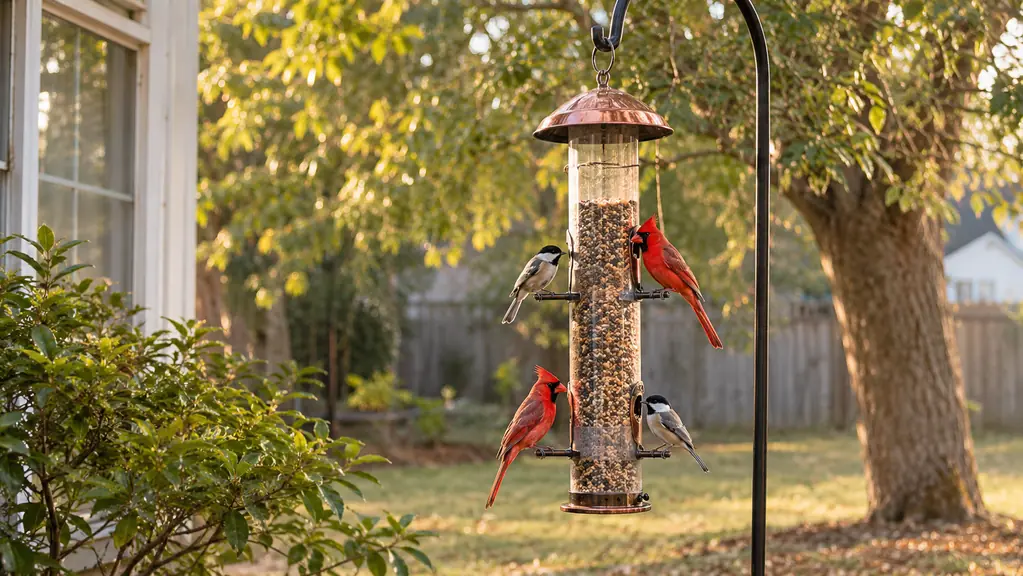
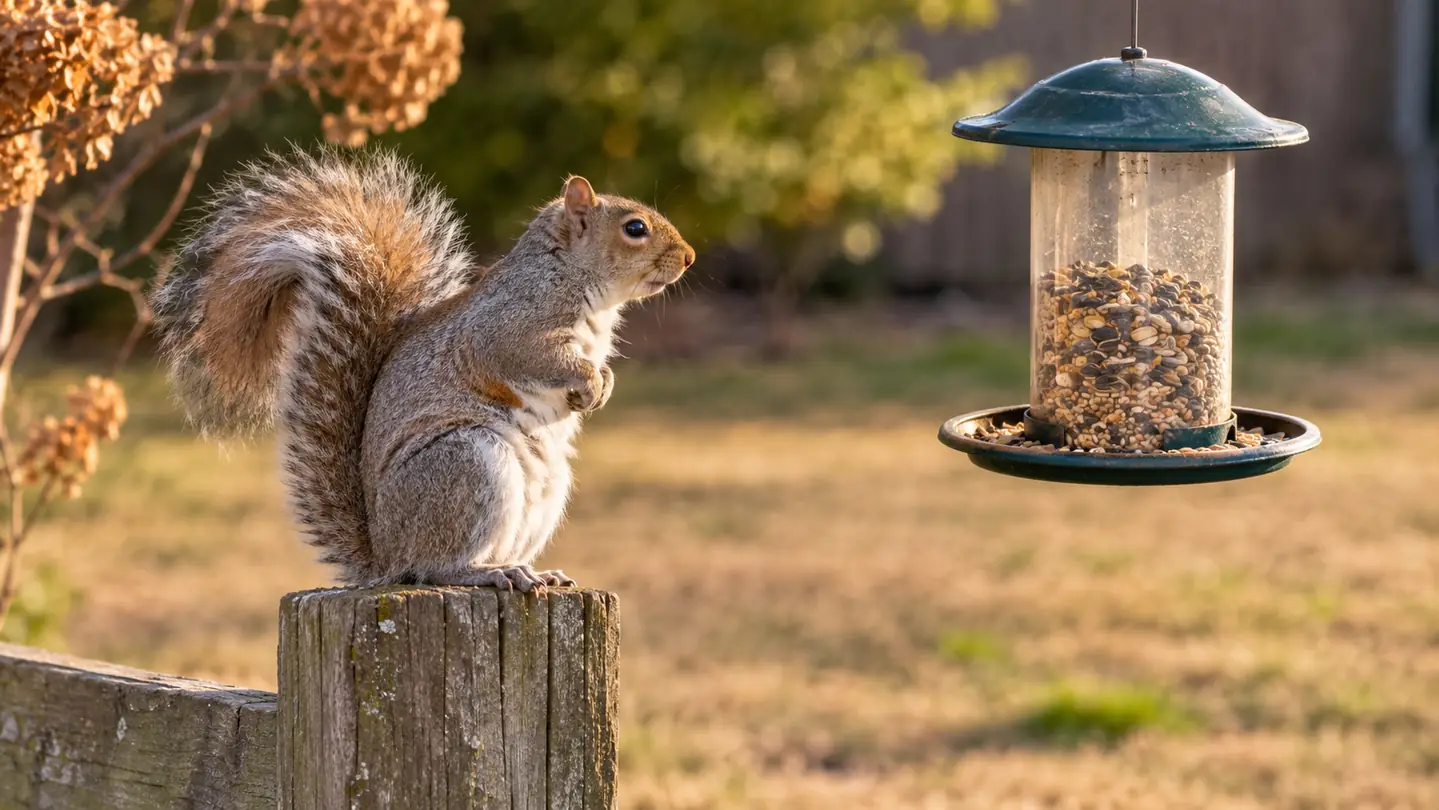
The first feeder I hung outside my kitchen window lasted four days. On the fifth morning a squirrel was sitting inside the seed tube like it had signed a lease, and the cardinals had moved into the pecan tree to sulk. I am not a person who declares war on wildlife. I am, however, a retired librarian with a quarter acre in Greenville, North Carolina, a husband named Earl who pretends not to care about the feeders, and a long memory. I tried three other feeders after that one. All three were, in the end, squirrel diners.
What finally worked was the Squirrel Buster Standard, made by Brome. It hangs by my kitchen window now, and it has been out there long enough that I have stopped thinking about it, which is the highest compliment I can pay a piece of equipment. Down the page are ten plain reasons it earns its place on the hook. No fluff, no bird-watching jargon, just what I have noticed from the sink with a coffee cup in my hand.
The feeder my cardinals came back for
A spring holds the shroud up for birds and lets it drop for anything heavier. That is the whole trick, and it is the reason my seed goes to the birds now.
Amazon Check Today's Price on Amazon →The ten reasons, in the order I would argue them
It closes the ports on the squirrel, not on the birds
The mechanism is simple and it is the entire idea. A spring in the hanger holds the shroud up, so the openings in the shroud line up with the feeding ports and a bird can reach the seed. Add more weight than the spring is set for and the shroud slides down, and the ports close. A cardinal weighs a small fraction of a squirrel. That is the gap the feeder is built around, and it is why the thing keeps working after a squirrel has spent twenty minutes climbing all over it.
The spring tension is yours to set
Not every back yard has the same problem. Mine has one heavy gray squirrel that has clearly been eating well, plus the usual smaller ones. Brome made the spring adjustable so you can decide how much weight the shroud will hold before it drops. I set mine on the tighter side, because I would rather a feeder be too sensitive than too generous. If your visitors run heavy, you can loosen it. It is a small adjustment, not a Saturday project.
Cardinals perch, so they get to eat like cardinals
The seed ports have perches, which sounds like a minor detail until you have watched a cardinal try to feed from a feeder that offers nothing but a wire cage. A cardinal wants to land and sit and take its time. The perch lets it. Mine come in around the same hour every morning now, and they are slow about it. They do not like being jostled. The perch is the reason they stayed once the squirrels stopped hogging the place.
Clinging birds get the wire shroud
Chickadees and Carolina wrens do not want to sit at a table. They want to grab something and hang. The wire shroud gives them a surface to cling to, and once they figure it out they use it constantly. My wren arrives, clings, takes one seed, and leaves, and then does it again all afternoon. I mention this because the shroud usually gets described only as squirrel armor. It is also something to hold on to, and the small birds around here treat it exactly that way.
1.3 pounds is more seed than it sounds
The feeder holds 1.3 pounds of seed and weighs 1.6 pounds empty. That is enough that I am filling it every few days instead of every morning, which matters when the weather is doing what eastern North Carolina weather does in February. A feeder that holds too much goes stale in the damp. One that holds too little turns into a chore. This one lands in the useful middle. I have never had seed sitting in it long enough to cake up.
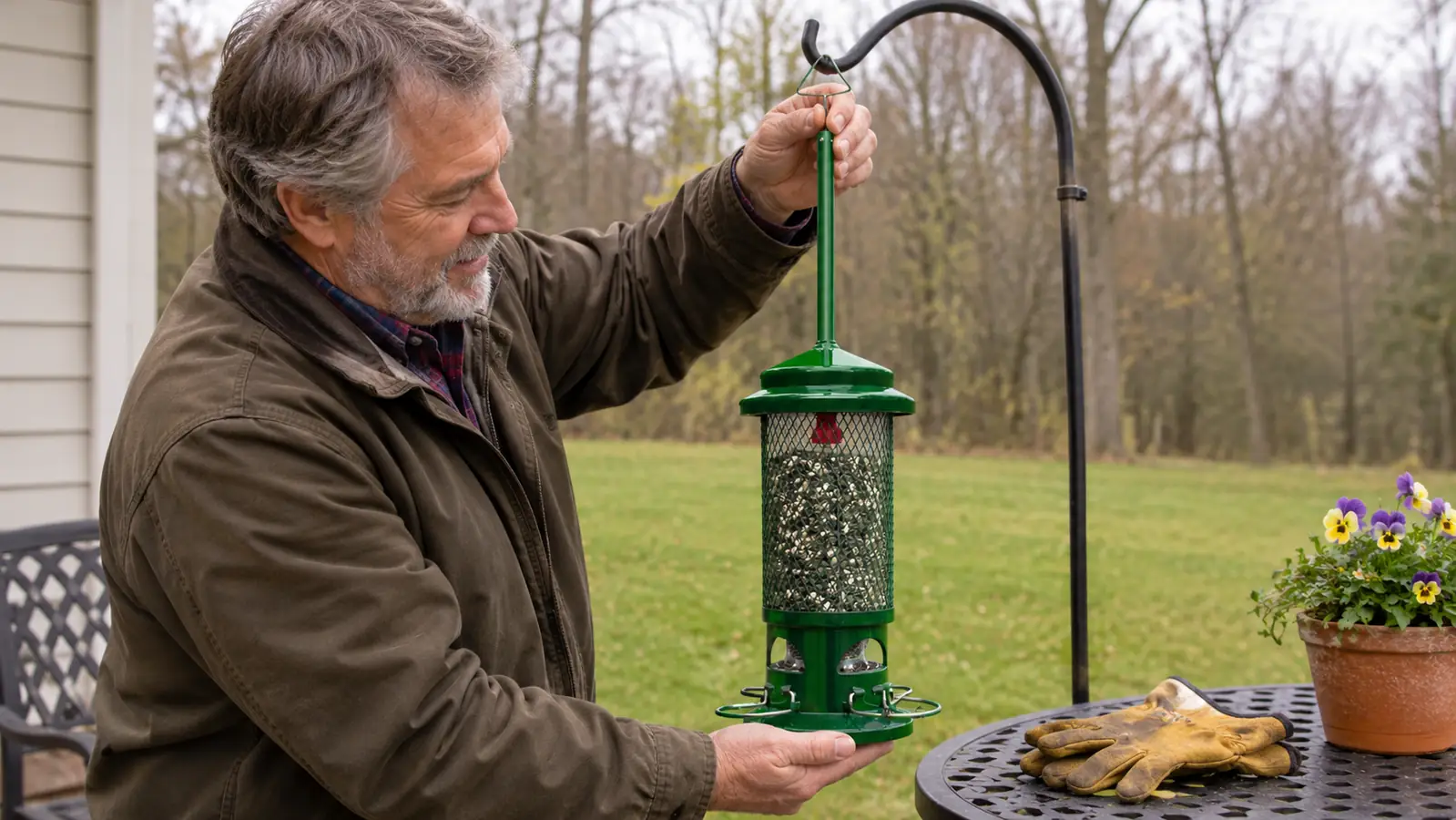
It hangs on a hook, in about a minute
The mounting type is a hanging mount, and that is the whole installation. Mine hangs from a shepherd's hook I already owned. No post to set in the ground, no bracket screwed into the siding, no ladder. If you are 67 and your knees have opinions, that detail counts for more than half the feature list. I can lift it off the hook, carry it to the patio, fill it, and hang it back before Earl has finished asking me what I am doing out there.
5 by 5 by 13.25 inches fits a window view
The dimensions are 5 inches wide, 5 inches deep and 13.25 inches tall, so it is tall and narrow rather than wide and sprawling. That shape is why I can hang it close to the kitchen glass without blocking the whole view. From the sink I can see the entire feeder and the pecan tree behind it. If your only good vantage point is a small window over a dish towel, the narrow footprint matters in a way you would not think about until you tried something wider.
The clear tube answers the refill question
The seed tube is transparent, and Brome notes that the clear tube traps solar energy. What I care about is plainer than that. I can glance out the window and know whether I need to go outside. Before this I was walking out to the feeder just to look at it, twice a day, for years. Being able to check from the sink is a small thing that adds up to a lot of saved trips across a winter.
The warranty tells you what Brome expects
This one carries a lifetime limited warranty. I have bought enough garden things over the years to read that as a statement of intent. A company does not put a lifetime warranty on a feeder it expects to give out in a season. The housing is plastic, and after a stretch of North Carolina sun and rain it still looks like itself. When something does wear out, I would rather deal with a company that planned for it than go buy a fourth feeder.
The squirrels eventually quit, and that is the payoff
Here is the part nobody mentions. Squirrels are not stupid. After several days of climbing a feeder that shuts its ports every time they grab it, most of them stop. Mine sits on the fence now and complains rather than trying. That does two things. It puts your seed back in front of the birds, and it gives you a small daily entertainment you did not plan on. I am not proud of how much I enjoy it. I am just telling you the truth.
What I'd Skip
Two feeders I would not spend on again. The first is the bargain one from the hardware store that is only squirrel-resistant because the whole thing spins and dumps your seed on the lawn. The second is a feeder with a cage so tight that the cardinals cannot get in. A feeder that beats the squirrel by beating the birds has not solved anything. Watch what actually visits your yard before you buy.
I would also skip this one if you want to fill a feeder once a month and forget it. At 1.3 pounds it is not a bulk silo, and in a hard freeze with a flock of house finches on it you will be out there every other day. That is an honest limitation, not a sales pitch. And if you keep an indoor bird like my budgie Pickle, remember this feeder is for the yard, not the cage. Anything about a bird's health goes to an avian vet, not to me.
The shroud drops, the ports close, and the squirrel sits there arguing with a feeder that will not answer.
Hang one before the next squirrel figures out your current feeder
Ten seasons of trying everything else is enough. The Squirrel Buster Standard is the one that stayed on my hook, and my cardinals came back because of it.
Amazon Check Today's Price on Amazon →