
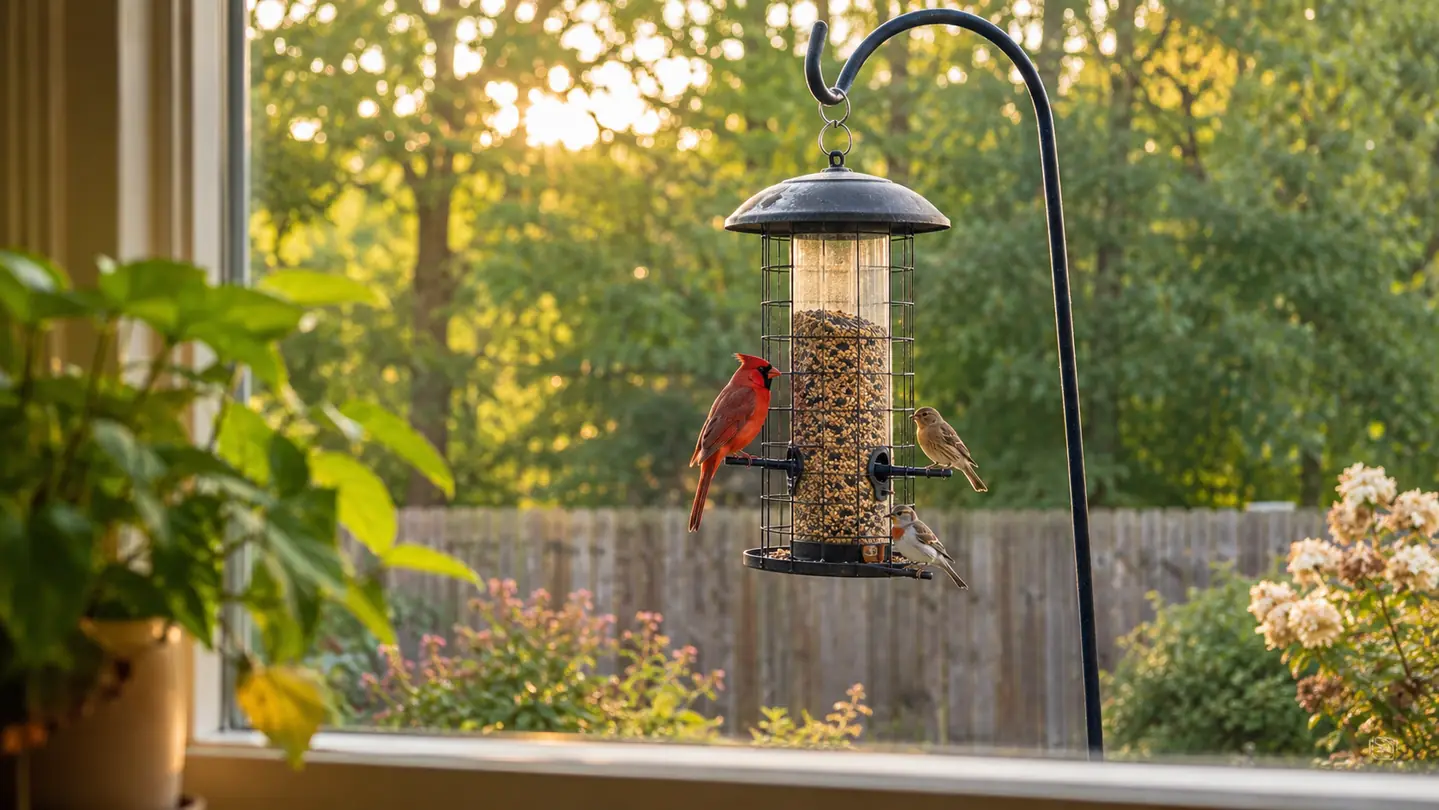
I have been at war with the squirrels in my back yard for eleven years, and I am not winning. They have chewed through a plastic feeder port, bent a metal hanger flat, and once emptied a tube feeder in a single afternoon while I was at the grocery store. So when I say I have opinions about squirrel-proof feeders, understand that those opinions were paid for in seed.
The two names that come up over and over are the Squirrel Buster from Brome and the Perky-Pet Squirrel-Be-Gone. They cost roughly the same kind of money, they hang from the same kind of hook, and they promise the same thing. But they go about it in completely different ways, and that difference matters depending on what your yard looks like and what kind of squirrel you are dealing with. Here is how they actually compare.
The Short Answer
The Brome Squirrel Buster Standard is the better feeder for most people, and it is not especially close. It holds 1.3 pounds of seed in a 5 by 5 by 13.25 inch tube, weighs 1.6 pounds empty, and uses a weight-adjustable spring mechanism so the outer shroud drops and closes the ports when something heavy lands on it. A cardinal or a chickadee does not trigger it. A squirrel does. It also carries a lifetime limited warranty, which tells you something about how the company expects it to hold up.
The Perky-Pet Squirrel-Be-Gone takes a different approach. It is a cage-style feeder, meaning the seed tube sits inside a metal grid cage so squirrels can grip the outside but cannot reach the ports. That works. It genuinely does. But it works by excluding rather than by reacting, and that changes who can eat from it. Which is why the answer is not quite as simple as "buy the Brome." It depends on what you are feeding and who you want at the table.
| Brome Squirrel Buster Standard | Perky-Pet Squirrel-Be-Gone | |
|---|---|---|
| How it stops squirrels | Weight-adjustable spring drops the shroud and closes the ports when something heavy lands | Metal cage around the seed tube keeps squirrels too far out to reach the ports |
| Capacity | 1.3 pounds of seed | Larger seed tube, holds more before a refill |
| Birds it accommodates | Perches at the ports plus wire shroud for clinging birds, so cardinals, finches and woodpeckers all feed | Cage openings sized for small birds, larger birds cannot reach in |
| Adjustability | Spring tension adjustable so you can tune it for your squirrels | Fixed design, no adjustment needed or possible |
| Cleaning | Shroud slides up and locks, tube comes apart for washing | Cage must be unclipped and the tube removed to clean properly |
| Warranty | Lifetime limited warranty | Standard one-year coverage |
| Squirrel frustration factor | Squirrel learns the feeder defeats it and usually moves on | Squirrel can still hang on the cage and pick at spillage |
| Best for | A yard with mixed birds and persistent squirrels | A small-bird yard where goldfinches and chickadees are the priority |
| Footprint | Compact 5 by 5 inch tube, hangs anywhere | Bulky cage takes up more hanging space and swings in wind |
Where the Brome Squirrel Buster Wins
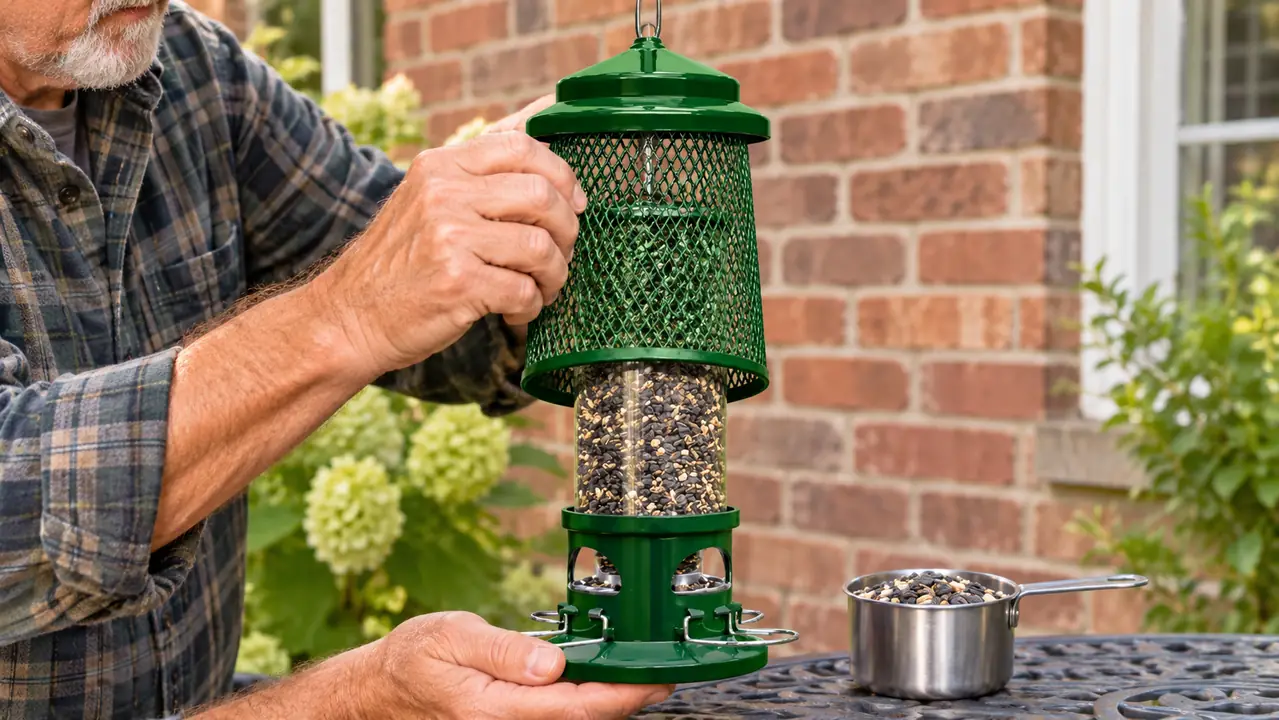
The spring mechanism is the whole reason this feeder has a following, and it is worth understanding before you buy anything. The outer shroud sits on an adjustable spring. Set it light and the shroud drops when a big bird lands. Set it heavier and only a squirrel's weight trips it. When the shroud drops, the openings in the shroud no longer line up with the feeding ports, so there is nothing to eat. The squirrel sits there on a closed feeder, confused, and eventually leaves.
My first setting was too light, and I knew it within an hour. A male cardinal landed on a Tuesday morning, all attitude and no patience, and the shroud dropped right on him. He sat on the closed feeder for a good ten seconds looking personally offended, then flew to the fence and glared at me through the kitchen window. I turned the tension a half turn heavier and he fed fine from then on. That is the entire tuning process. One visit from one bird tells you whether you have it right, and then the cardinals and house finches I actually want are light enough that the shroud never moves again.
What I did not expect was how much the clinging-bird thing would matter. The wire shroud gives birds something to grab onto, so the woodpeckers and nuthatches that used to ignore my tube feeders now stop by. And the transparent seed tube traps solar energy, which sounds like marketing language until you notice the seed does not clump up the way it did in my old feeder after a wet week. We had four days of drizzle in early March, and the sunflower seed in the Brome stayed loose and poured while the seed in the old tube feeder I keep as a spare turned into a brick I had to chisel out with a spoon. The shroud lifts and locks for refilling, which takes about thirty seconds. For a 67-year-old with a bad shoulder, that is not a small thing.
The lifetime limited warranty also deserves a mention. I have replaced three feeders in eleven years. Three. One had a port cracked by a squirrel, one had a hanger bent flat, and one simply went brittle and split along the seam after two hard winters. If any of those had come with a warranty that lasted longer than a season, I would have come out ahead. That is part of what you are paying for here, and it should be part of how you think about the cost.
Where the Perky-Pet Squirrel-Be-Gone Wins
Here is the honest part. The cage design has one real advantage, and it is capacity. The seed tube inside that cage holds noticeably more than 1.3 pounds, so you are not refilling it every other day in a busy yard. In a normal week on my patio, the Brome gets topped off about every third morning. The Perky-Pet stretches that out, and in a week when I was down with a cold and not going outside in the damp, that mattered more than I expected. The Brome is a smaller feeder, and small feeders mean more trips out the back door.
Second, there is nothing to adjust and nothing to break. The Perky-Pet has no spring, no tension to fiddle with, no mechanism that can lose its calibration after two winters of freezing and thawing. It is a tube inside a cage. My husband Earl, who is skeptical of anything with moving parts, pointed this out and he was right. If you want a feeder you hang and forget, the simplicity is a genuine point in its favor. It also does a fine job of keeping out the bigger birds, which some people want, because the grackles can clean out a feeder in an afternoon and then sit in the pecan tree looking pleased with themselves.
A feeder that fails after two winters is not cheaper than one that comes with a lifetime limited warranty. It is just a slower way to spend the same money.
The Squirrel Problem You Actually Have
Before you pick either one, think about what your squirrels are doing. If they are climbing the pole, hanging upside down from the hanger, and shaking seed onto the ground, both feeders will frustrate them eventually, but the Brome gets there faster because the feeder physically closes. If your squirrels are the type that sit on the cage of a Perky-Pet and patiently pick at whatever falls, you will still be sweeping up seed. I have watched one particular squirrel do exactly that for twenty minutes at a stretch, unhurried, like a man at a buffet who knows the staff will not ask him to leave.
The other thing to consider is what you are feeding. The Brome is rated for cardinals and works well for a mixed yard. If you are running a small-bird mix for goldfinches, the cage on the Perky-Pet does a better job of keeping the bigger birds off. That is not a flaw in either feeder. It is a question of what you want in your yard, and no product description can answer it for you.
One more consideration: mounting. Both are hanging feeders, so both need a hook or a pole. If you already have a shepherd's hook by a window, either one will work. If you are starting from scratch, budget for the pole as well, because a squirrel can absolutely reach a feeder hanging low enough from a fence rail, and it will find that out before you do.
My Own Boneheaded Mistake
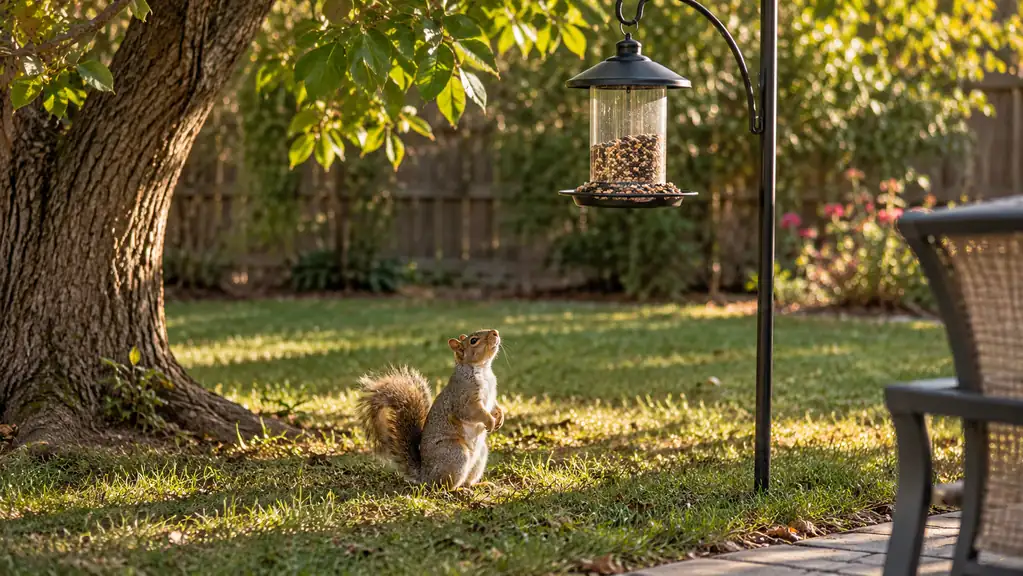
The first year I owned a squirrel-proof feeder, I hung it four feet from the fence and could not understand why the squirrels kept getting to it. They were jumping from the fence rail. I moved it six feet out into the yard and the problem mostly stopped. Then I moved the hook again, to about eight feet from anything a squirrel can launch from, and it stopped entirely. No feeder, no matter how well designed, will save you if you hang it where a squirrel can leap onto it. I tell you this because I wasted a solid month being annoyed at a feeder that was doing exactly what it was built to do.
I also learned to check the spring tension in the fall. The adjustment can work loose over a summer of swinging in the wind, and if it loosens enough, the shroud gets too easy to drop and the bigger cardinals trip it. It takes about a minute, twice a year, once in October and once in March when the weather turns. The manual that comes in the box explains it, and it is genuinely a manual worth reading, which is not something I say often about anything that comes in a box.
Who Should Buy Which
Buy the Brome Squirrel Buster Standard if you have a mixed yard, if you want cardinals and finches and the occasional woodpecker, if your squirrels are persistent enough that you have already lost a feeder to them, and if you would rather adjust a spring twice a year than sweep seed off the patio every morning. It is also the one I would pick if you are buying a feeder for the first time and want to buy it once. The lifetime limited warranty does a lot of work in that decision.
Buy the Perky-Pet Squirrel-Be-Gone if your priority is a large seed supply that lasts through a busy week, if you are specifically feeding small birds and want the bigger ones excluded, and if you want a feeder with no adjustments to think about. It is a good feeder. It is just a feeder built around a different idea, and if that idea matches your yard better, you should follow it.
The feeder the squirrels stopped bothering with around week three
For a quarter-acre yard with cardinals, chickadees, wrens, house finches and one very determined squirrel family, the Brome Squirrel Buster Standard has been the one that actually ended the argument. Weight-adjustable spring, clinging-bird shroud, and a lifetime limited warranty.
Amazon Check Today's Price on Amazon →One Last Thing About Feeding Birds
Whichever feeder you land on, clean it. A feeder that stays out through the summer without a wash is a good way to make your birds sick, and no squirrel-proof mechanism solves that. I take mine down once a month, scrub it with a mild soap solution, rinse it well, and let it dry completely in the sun before refilling. It is a fifteen-minute job and it is the single most useful thing I do for the birds in my yard.
And if you keep a pet bird indoors, keep the outdoor feeders away from the cage and wash your hands between the two. Pickle does not need anything the cardinals are carrying. For anything beyond that, ask an avian vet, because that is past what a retired librarian with a seed scoop should be answering.
The short version: two good feeders, two different strategies, and one of them fits your yard better than the other. The Brome fits most yards, including mine. If yours is the exception, now you know why.
Stop refilling a feeder the squirrels are emptying anyway
The Brome Squirrel Buster Standard holds 1.3 pounds of seed, closes its ports under a squirrel's weight, and comes with a lifetime limited warranty. It hangs from a standard hook and comes apart for cleaning.
Amazon See the Squirrel Buster Standard on Amazon →