
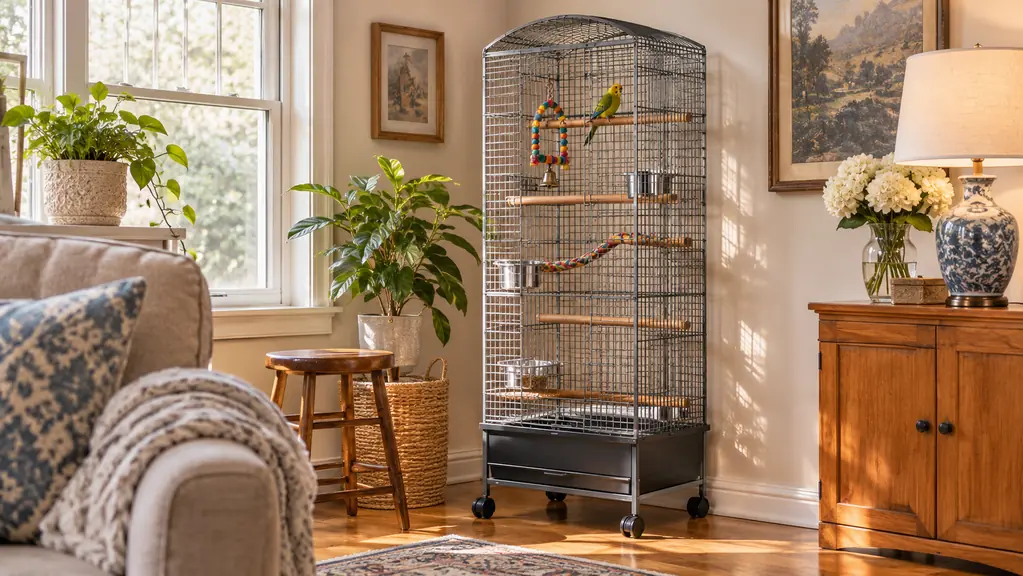
Pickle is six years old, about thirty five grams, and by far the loudest thing in this house before eight in the morning. He came to us in a cage that was fine for the ride home and wrong for every day after it. A budgie does not walk anywhere. He flies, or he ought to. A short cage turns a bird into a perch ornament, and after a few months of watching mine take two steps, turn around, and take two steps back, I ordered the Prevue Pet Products Steel Bird Flight Cage with Wheels. It took me most of a Saturday afternoon to set up, and I did two things wrong the first time through. Both of them were placement decisions, and both of them cost me an evening of undoing.
Here is what is in the box, so you know what you are handling before it is on the floor. The cage is 31 inches long, 20.5 inches wide and 53 inches tall. It weighs 19 pounds and it rolls on its own wheels. The wire spacing is 1/2 inch, which is the number that matters most for a budgie. You get four feeders, two doors, nest box doors on each side, three levels, a removable tray and three perches. None of that is hard to put together. What makes it a job is that a live bird is going to move in, and birds are deeply suspicious of new things. The order below is built around that.
The cage that gives a budgie room to fly instead of room to shuffle
31 inches long, 53 inches tall, 1/2 inch bar spacing, four feeders, two doors, and wheels so it can follow the sunlight around the room. This is the one sitting in my living room.
Amazon Check Today's Price on Amazon →Step 1: Pick the spot before you touch a single panel
Choose a wall in the room where people actually sit. Not the spare bedroom with the door shut, not the laundry room. Budgies are flock birds, and mine is only settled when he can see what the flock is doing. He wants to hear the kettle and the television and Earl complaining about the weather. A bird alone in a quiet room is a bird that either gets loud for attention or goes quiet in a way that worries you.
Keep it out of the kitchen. An overheated nonstick pan gives off fumes that kill small birds quickly, and that is not something I am willing to be casual about. Skip the spot over a heating vent, the spot in a direct blast from a door that opens all winter, and the spot where afternoon sun lands on the wire for three hours straight. Then look up. At 53 inches, the Prevue Pet Products cage stands taller than our sideboard, and in a lot of houses that puts it under a ceiling fan. Move the fan or move the plan, because a ceiling fan and a tall cage do not negotiate.
My first mistake was the corner beside the fireplace, which looked charming in my head and was wrong in the room. The mantel is where the house heat pools, the brick holds it, and that corner runs several degrees warmer than the rest of the room by evening. Pickle sat on the top perch with his beak open for two days before I understood what I was doing to him. I moved the whole cage nine feet to the wall by the bookshelf and he was chattering again by the next morning. The wheels turned that into a two minute job instead of an afternoon with a wrench.
My second mistake was orientation. I had the front facing the wall for the first hour because it fit the room better, and he spent that hour pressed into the back corner of the cage. Now it sits against a solid wall with the front facing the room, which gives a nervous bird one less direction to watch. Then I roll it out about a foot to vacuum and roll it back. A cage you cannot move is furniture.
Step 2: Assemble it where it will live
Build it in the room. Not the garage, not the driveway, not the hallway. It is 31 inches long and 53 inches tall, and it does not go through a doorway politely once it is together. Lay the panels on an old blanket, keep the hardware in a bowl so you are not crawling around for a bolt, and read the sheet that came with it once before you start. I did not, and I had two panels reversed for twenty minutes, which is exactly long enough to convince yourself the factory sent the wrong part.
Nineteen pounds is not heavy. It is awkward. The frame wants to swing while you stack the upper section, so have a second person hold it steady for the top two minutes. Earl held, I bolted, and we had the frame standing before the coffee went cold. Then check the whole thing for square before you tighten anything down hard. If the doors do not line up, something below them is not seated.
Set the base on its wheels before you load anything into it, and give it a nudge on the floor where it will actually live. Carpet and tile are different worlds, and a cage that rolls fine on hardwood can dig in on a rug. Once it is level, finish tightening, then open and close both doors a few times and slide the removable tray in and out. If the tray drags, the frame is racked and you need to loosen, square it, and start again. The warranty is 90 days, so do this checking before the box goes out to the curb.
Step 3: Perches and feeders, in that order
The 1/2 inch wire spacing is the right size for a budgie, and it is also the number that tells you his head will not go through it. That is the single most reassuring thing about this cage to me. Everything else is convenience. That number is safety.
Perches first. Prevue Pet Products includes three 5/8 inch diameter perches, and I keep one of those low near the tray where it is easy to wipe. Higher up I add natural branches in a couple of diameters, because a bird's feet should not grip the same smooth dowel every day of his life. Put the highest perch at one end for sleeping, high enough that he can look down at the room, and leave clearance above it so his head is not against the ceiling wire. Do not put a perch directly over a feeder. You will be scraping seed off that dish forever, and the bird will be eating around his own droppings.
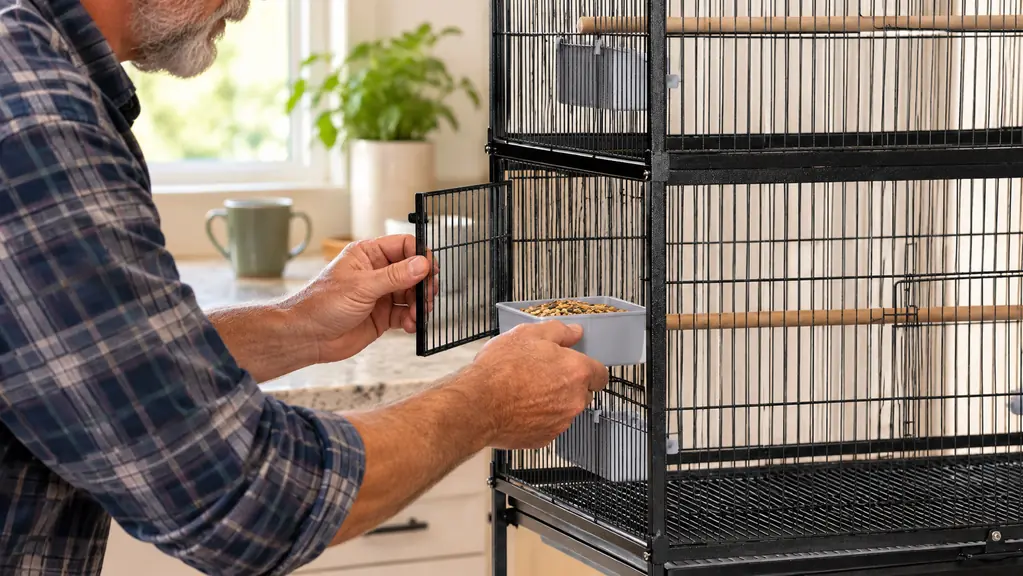
Then the feeders. Four come with the cage. I run two for seed and pellets and two for water, and I keep a clean spare pair in the cabinet so swap day is a swap and not a scrubbing project. The nest box doors on each side are more useful than I expected. On a cage this long, reaching a dish from the side instead of leaning through the front door means I am not chasing a loose budgie around the living room at seven in the morning. The first week I tried doing all four dishes through the main door. I lost a full scoop of seed to the carpet and about ten minutes of my patience, and then I started using the side doors like a sensible person.
Fifty three inches of height does more for a budgie than any toy in the pet store, because it lets him go up when he is nervous and come down when he wants company.
Step 4: Toys, and the flight path you have to protect
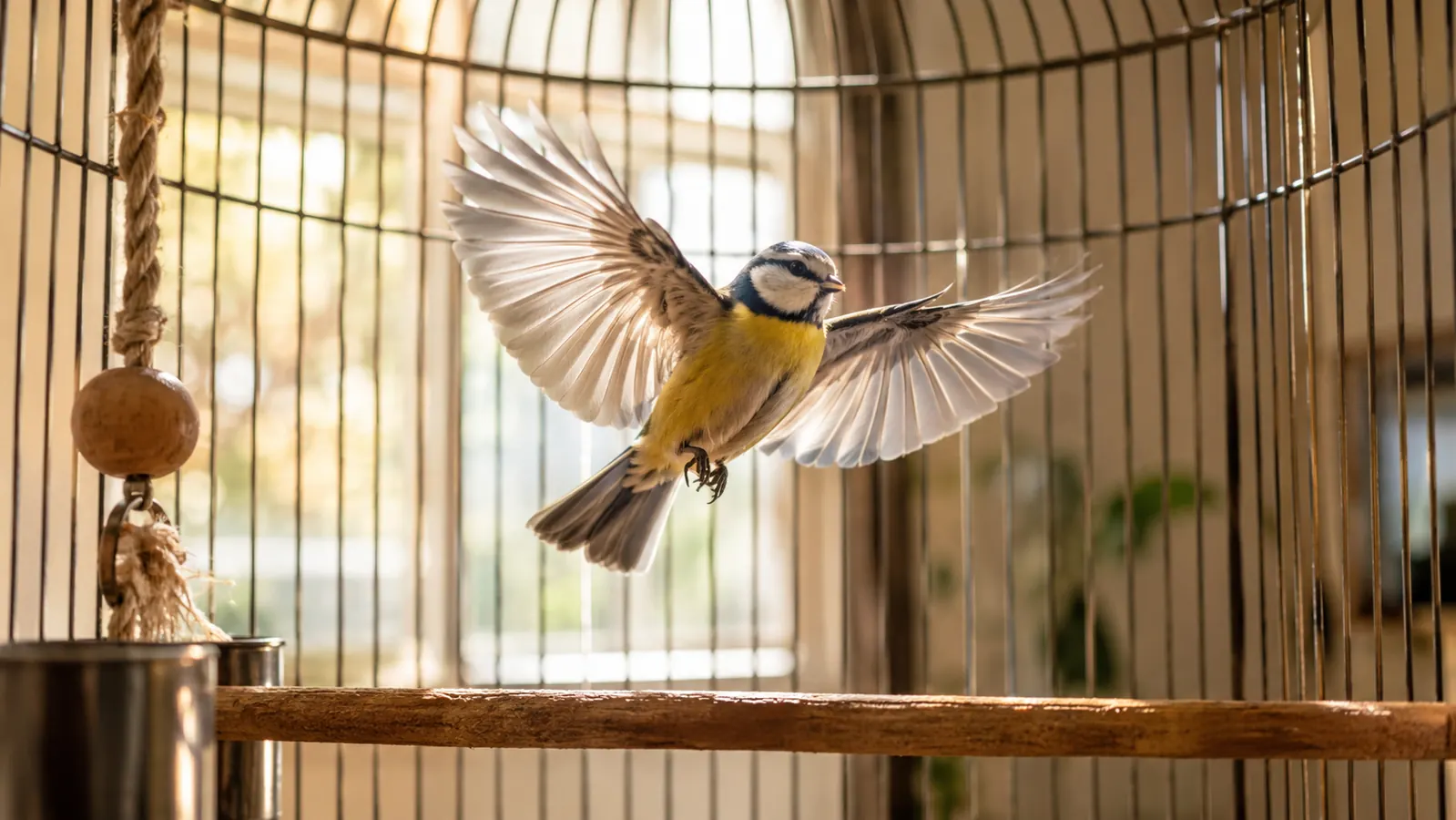
The whole point of a flight cage is horizontal room, and the fastest way to waste 31 inches is to hang something in the middle of it. Keep the center open from the top perch down to the lower one. Toys go at the ends and along the sides, where they catch a wingtip instead of blocking a landing.
I rotate three at a time: something to shred, something to swing on, and something to take apart. Paper, soft wood, a small swing. A budgie with the same four toys for a year stops playing with all of them. Every Sunday I swap two out and put the others in a drawer, and every Sunday they are new again. It costs nothing and it is the difference between a bird that has toys and a bird that plays.
I keep mirrors out of the cage. Some birds do fine with them and some become fixated on the bird in the glass, and mine is the fixated kind. That is my call for my bird, not a rule for yours. What I would call a rule is this: nothing with a loose loop of thread, nothing with a bell he can wedge his beak into, and nothing you would not want him chewing for six hours straight.
Step 5: Move the bird in over three days, not one afternoon
Do not transfer your bird the same day you build. Leave the new cage standing empty in the room for a day or two so it becomes part of the scenery instead of an event. Put two of his current toys inside so something in there smells like him and the whole thing is not strange from top to bottom.
Move him in the evening, in dim light, when he is already calm and half asleep. Keep the old cage in the room, closed, for three or four days. He can see it. He can go back if the new place turns out to be terrible. Most budgies settle faster with that option sitting there than they do when the old cage vanishes overnight.
Then watch the boring things, day by day, because the pattern tells you more than any single moment. Day one, mine stayed on the lowest perch and would not climb. Day two he found the middle level and sat there most of the afternoon. By the end of the week he was making the short flight from the top perch to the far feeder and back, which is the entire reason for 31 inches of length. Is he eating? Are the droppings normal in color and amount? Is he up top chattering at dawn, or flattened against the wire? A budgie that stops eating needs an avian vet, not a longer adjustment period.
I also keep an inexpensive kitchen scale and weigh mine once a week for the first month, because thirty five grams does not leave much margin, and weight loss shows on the scale before it ever shows in behavior. Mine dropped two grams in the first four days and had it back by the tenth. I would not have known either number without the scale, and I would have spent that week guessing.
What Else Helps
A stool. This is the unglamorous one. The top of this cage is above eye level for me at 67, and reaching the upper perch to wipe it means standing on something solid. Get a small step stool that lives beside the cage instead of dragging a kitchen chair over twice a week. I tried the chair first. The chair is heavier than it looks, it scuffs the floor, and it is never where you left it.
A cover for the evening. Budgies need a genuinely dark night, and a living room with a television in it does not deliver one. A sheet does the job and also gives you a way to settle a bird that has wound himself up. Line the removable tray with newspaper or plain paper and morning cleanup is about ninety seconds: slide the tray out, roll the paper up, drop a fresh sheet in.
And a baseline visit with an avian vet if you have not had one. I am a retired school librarian, not a veterinarian. I can tell you what worked in my living room and I cannot tell you why a bird is fluffed up on the floor of the cage. Find that vet before you need one, write the number inside a cabinet door, and go from there.
Three levels, four feeders, and room enough for a real flight across the middle
Prevue Pet Products sized this one for small birds: 31 x 20.5 x 53 inches, 1/2 inch bar spacing, two doors, and wheels so it can follow the light. Mine has been rolling for years.
Amazon Check Today's Price on Amazon →