
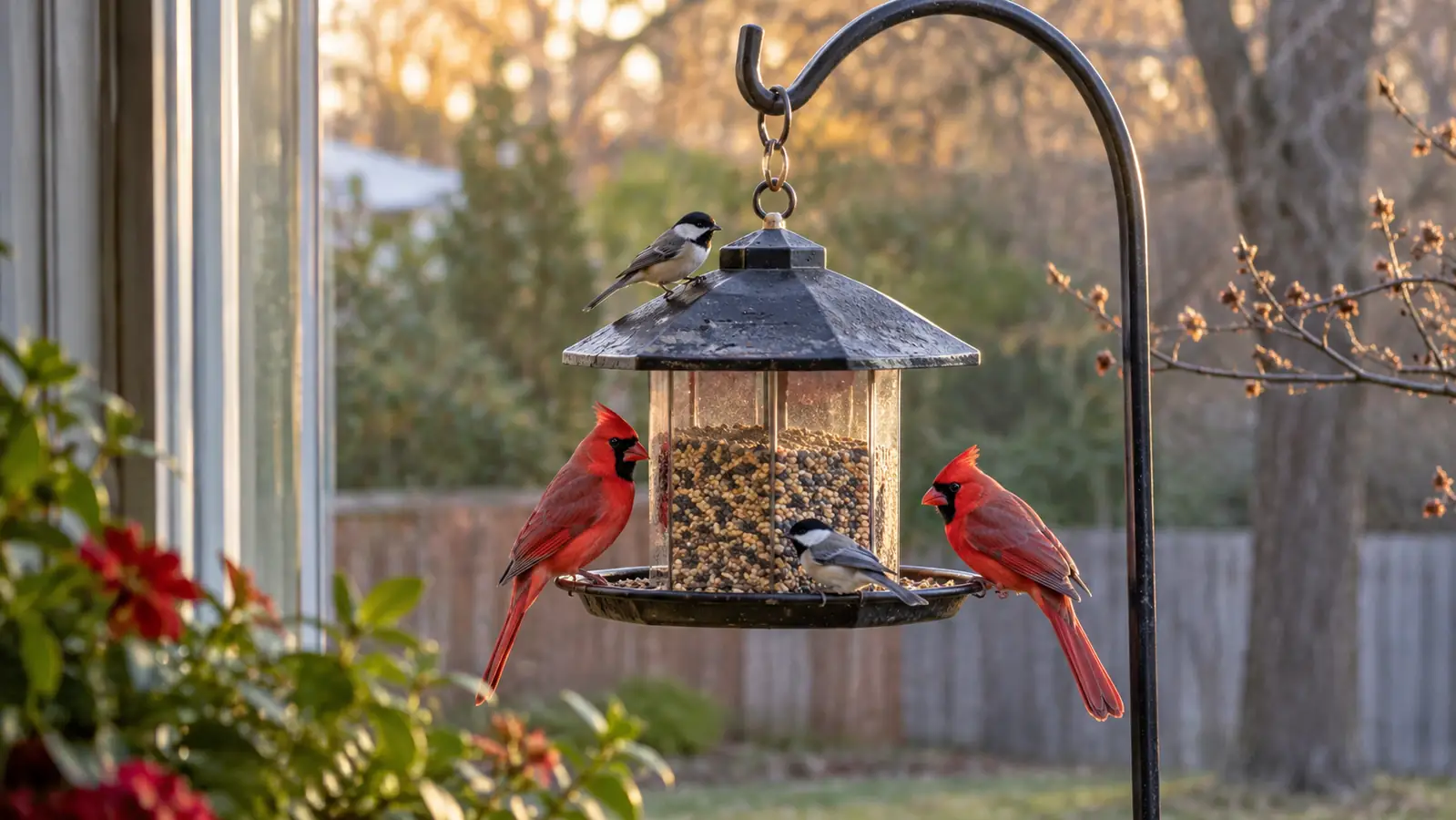
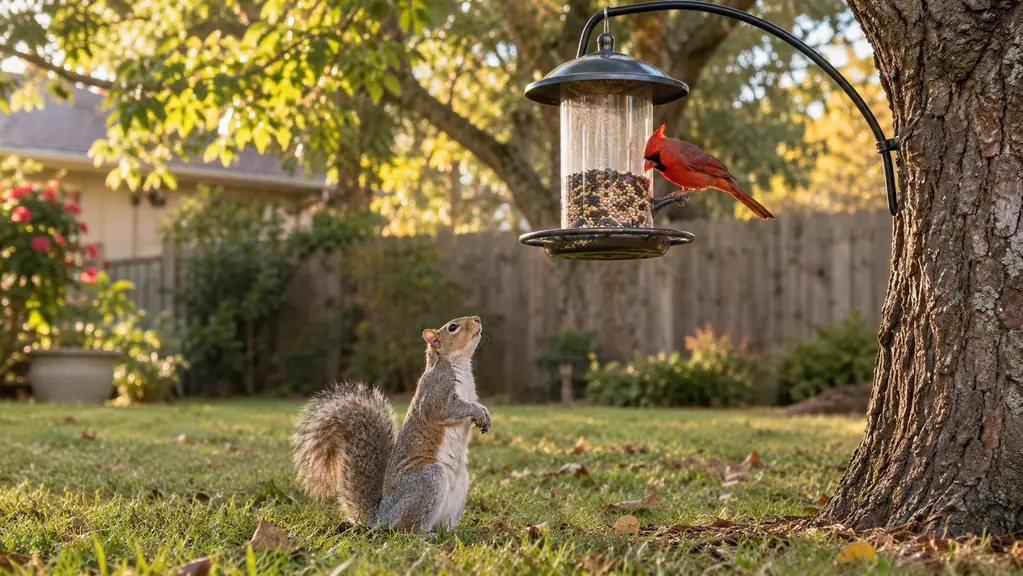
The squirrel in my pecan tree is not a casual visitor. He is a professional. He knows what time I fill the feeders, he knows which hook sags, and he has worked out the exact branch he needs to launch from to land on the roof of my tube feeder. For two winters I fought him with grease, with a baffle that turned out to be a squirrel staircase, and once, shamefully, with a squirt bottle I kept under the sink. He won every round, and he ate like a king while my cardinals sat in the shrubbery waiting their turn.
What ended the argument was a feeder that does the arguing for me. Two springs ago I hung a Brome Squirrel Buster Standard on the shepherd's hook outside my kitchen window here in Greenville, North Carolina, and the whole business settled down in about four days. Not because I got smarter. Because the feeder puts a moving shroud between the seed and anything heavy enough to be a squirrel, and it lets the birds through. The seed sits in a clear tube. Around that tube is a wire shroud with openings cut into it, and a patented spring holds the shroud up so those openings line up with the feeding ports. A chickadee is light enough that the spring barely notices. A squirrel is not. His weight pulls the shroud down, the openings slide out of line, and the seed is suddenly behind a closed door. The spring is weight adjustable, so you decide how much weight the shroud will support. That one adjustment is where most people go wrong, and it is where we are going to start.
One feeder, one adjustment, and the squirrel stops getting a vote
The Brome Squirrel Buster Standard holds 1.3 pounds of seed, hangs from a hook, and comes with a lifetime limited warranty. It is the only feeder on my hook that has outlasted that squirrel.
Amazon Check Today's Price on Amazon →Step 1: Hang It Somewhere the Jump Doesn't Work
A squirrel-proof feeder can only do its job if the squirrel has to put his weight on it. If he can reach a port from a branch, a fence top, or the roof of the house, the spring never gets a chance to do anything. Squirrels are better athletes than most people give them credit for. They can clear a surprising distance sideways without working up a sweat and they can launch upward from a standing start.
My own fix was simple and annoying: I moved the hook. It now sits out from the pecan tree and well back from the fence line, at the edge of the little patio, hanging about five and a half feet off the ground. That last number is for me, not for the birds. I am 67 and I do not want to fetch a step stool out of the garage every time I refill it. The birds do not care how high it hangs as long as it is clear of the shrubbery and out of the cat's reach.
Walk around your own yard and look for the launch points before you commit to a spot. The gutter on the corner of the house. The top of a privacy fence. The one low limb you have been meaning to trim since spring. Any of those within a short leap is a squirrel highway, and you have two choices: move the feeder or cut the limb. Brome sells the feeder, not the pruning saw, and I have needed both.
Step 2: Set the Spring for Your Birds, Not for the Squirrel
This is the step people skip, and it is the step that decides whether the feeder works for you or against you. The spring controls how much weight the shroud will support. Set it to support too little and your cardinals get the door shut in their faces. Set it to support too much and a small squirrel can hang there and eat while you watch from the window with your mouth open.
Start with the birds. Sit at the kitchen window with a cup of coffee and watch what happens when a cardinal lands. A cardinal is the heaviest regular at my feeders, so he is the one I calibrate against. If the shroud drops and the openings slide shut on him, the spring is holding too little weight. Nudge the setting up until he lands, eats, and the shroud stays where it belongs. Chickadees, house finches and Carolina wrens all weigh less than he does, so once the cardinal is comfortable, they will be fine.
Then let the squirrel run the test for you. I did not have to wait long. He came down the pecan trunk, crossed the grass, and hit the feeder from the side. The shroud dropped under him, he lost his footing on the wire, and he went down to the lawn looking personally insulted. I have never enjoyed a cup of coffee more. If your squirrel manages to hang on anyway, he is reaching from somewhere he should not be able to reach from, and you are back at Step 1.
Step 3: Fill It So the Mechanism Can Move
The Squirrel Buster Standard holds 1.3 pounds of seed, and the empty feeder weighs 1.6 pounds, so your hook is carrying close to three pounds when it is full. That is worth knowing before you hang it from a nail you tapped into a porch post sometime in the last century.
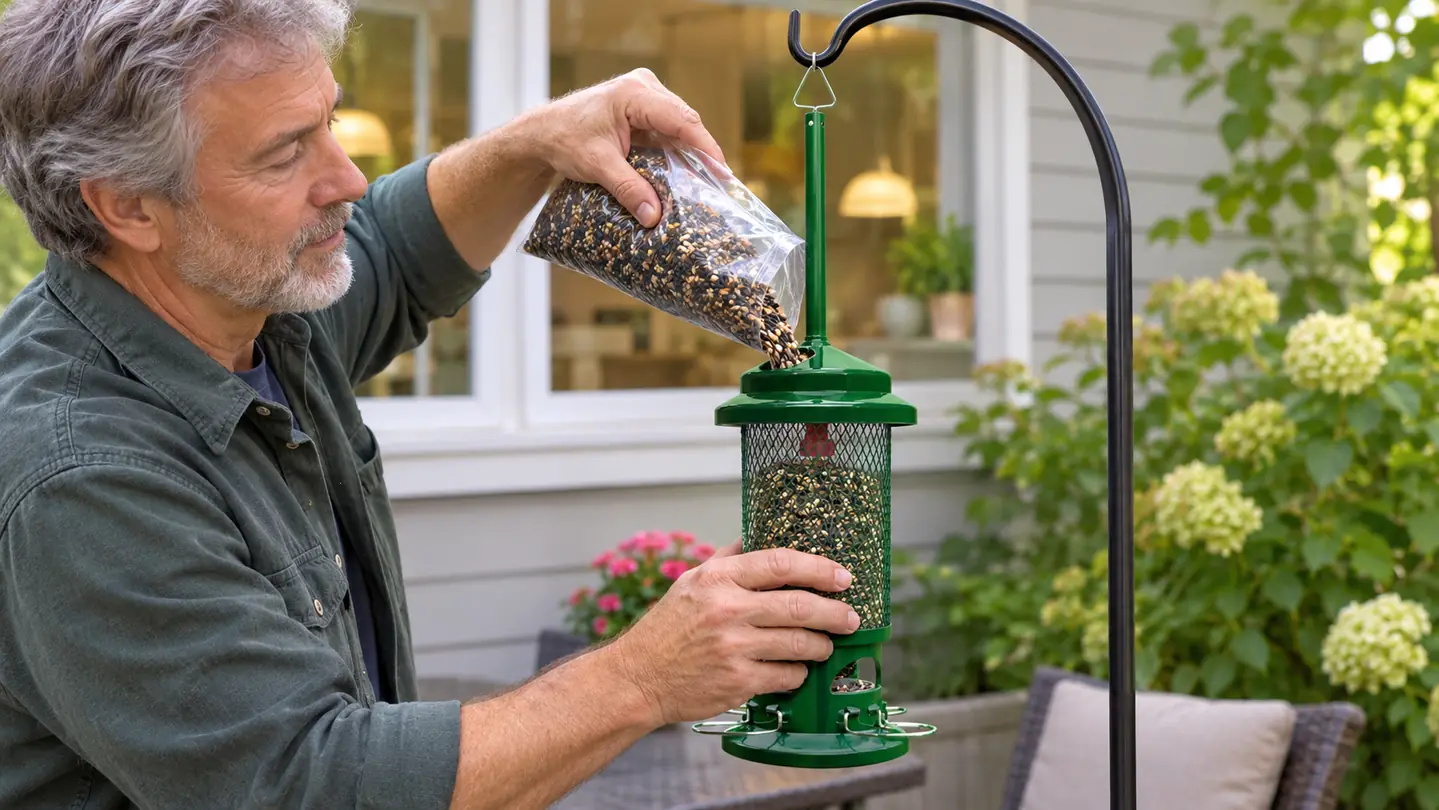
Fill the tube with dry seed and do not pack it down. Black oil sunflower is what I use, because cardinals, chickadees, wrens and finches all take it and it does not turn to dust in the bottom of the tube the way the cheap blends do. Fill it outdoors if you can. A funnel helps, and a kitchen floor does not.
Before you fill, lift the shroud and let it settle back so the openings are lined up with the feeding ports, then hang the feeder and check that it sits level. A feeder hanging cockeyed will still function, but that shroud travels on a spring and you want it moving freely, not rubbing against a crooked hook every time a bird lands.
Day four was the last time that squirrel got a sunflower seed out of my feeder. He still comes by. He just does not stay.
Step 4: Let the First Squirrel Teach You What to Fix
Do not stand out in the yard clapping your hands for a week. Watch from the window instead. The first squirrel visit tells you nearly everything you need to know: whether he can reach the feeder from somewhere he should not, whether he can get a grip on the wire shroud and hang there, and whether the shroud settles back where it belongs after he leaves.
If he can hang on the wire and reach over the top, you have a placement problem, not a feeder problem, and the fix is a hook in a different spot. If the shroud stays down after a bird leaves it, something is rubbing or the spring needs a small nudge. If he gets a meal, look hard at what was different about that one visit before you decide the feeder does not work. Brome built this thing to cycle every time something lands on it, and the mechanism is the part to check.
Cleaning is the other half of this step, and it is the half nobody photographs. Empty the tube, wash the feeder in warm soapy water, rinse it well, and let it dry in the sun before you refill. Once a week in hot weather is what I do, and every couple of weeks in the winter. Dirty feeders spread illness among birds, and a sick cardinal at your window is a sad thing you can prevent with a bucket and ten minutes.
Step 5: Fine-Tune It After the First Two Weeks
Squirrel pressure is not constant, and neither is bird traffic. In late summer and fall, when the young ones are out and everybody is caching for winter, my feeder gets hit a dozen times a day. In February it might be twice a week. That is why I check the spring setting at the change of a season rather than setting it once and forgetting it entirely.
After a hard freeze, make sure the shroud moves freely before you walk away from it. A little ice in the wrong place will hold it down and lock the birds out for a day. The same goes for a hook that has worked loose in the wind, and for the wire on the shroud, which is worth a glance while your hands are already out there.
And keep the receipt in the kitchen drawer. My Brome feeder carries a lifetime limited warranty, and if a part ever fails I want to find the paperwork without turning the house upside down. That is the whole maintenance routine: fill it, wash it, check the spring twice a year, and enjoy the fact that your seed is going to birds again.
What Else Helps
A squirrel-proof feeder is the center of the plan, not the whole plan. I still trim the pecan limb that reaches toward the patio, and I still keep a second, cheaper feeder at the far end of the yard. Call it a decoy. It costs me a few pounds of seed and it keeps the squirrels busy in a corner where nothing important is happening. A baffle on a pole feeder is worth having too, provided you grease nothing and mount it far enough from a launch point to matter.
Skip the petroleum jelly and the grease tricks. They get on feathers, they do not stop a determined squirrel, and they are miserable to clean off a feeder in July. Skip the slinky as well, unless you enjoy watching a squirrel treat it as a piece of gym equipment. What works is distance, a feeder that closes under weight, and patience while the local squirrels revise their opinion of your yard.
The honest tradeoffs are worth saying out loud. A 1.3 pound hopper is not a big one, so during a cold snap with cardinals working the feeder all morning I am out there refilling every few days. And if you overtighten the spring to spite a clever squirrel, you can shut out your larger birds along with him, which is why I set mine by watching the cardinals and let the squirrels be annoyed.
Two springs on the same hook. The squirrel is still in the tree, and he is still not eating my seed.
The Squirrel Buster Standard from Brome: hanging mount, 1.3 pound seed capacity, weight adjustable spring, and a lifetime limited warranty.
Amazon Check Today's Price on Amazon →