
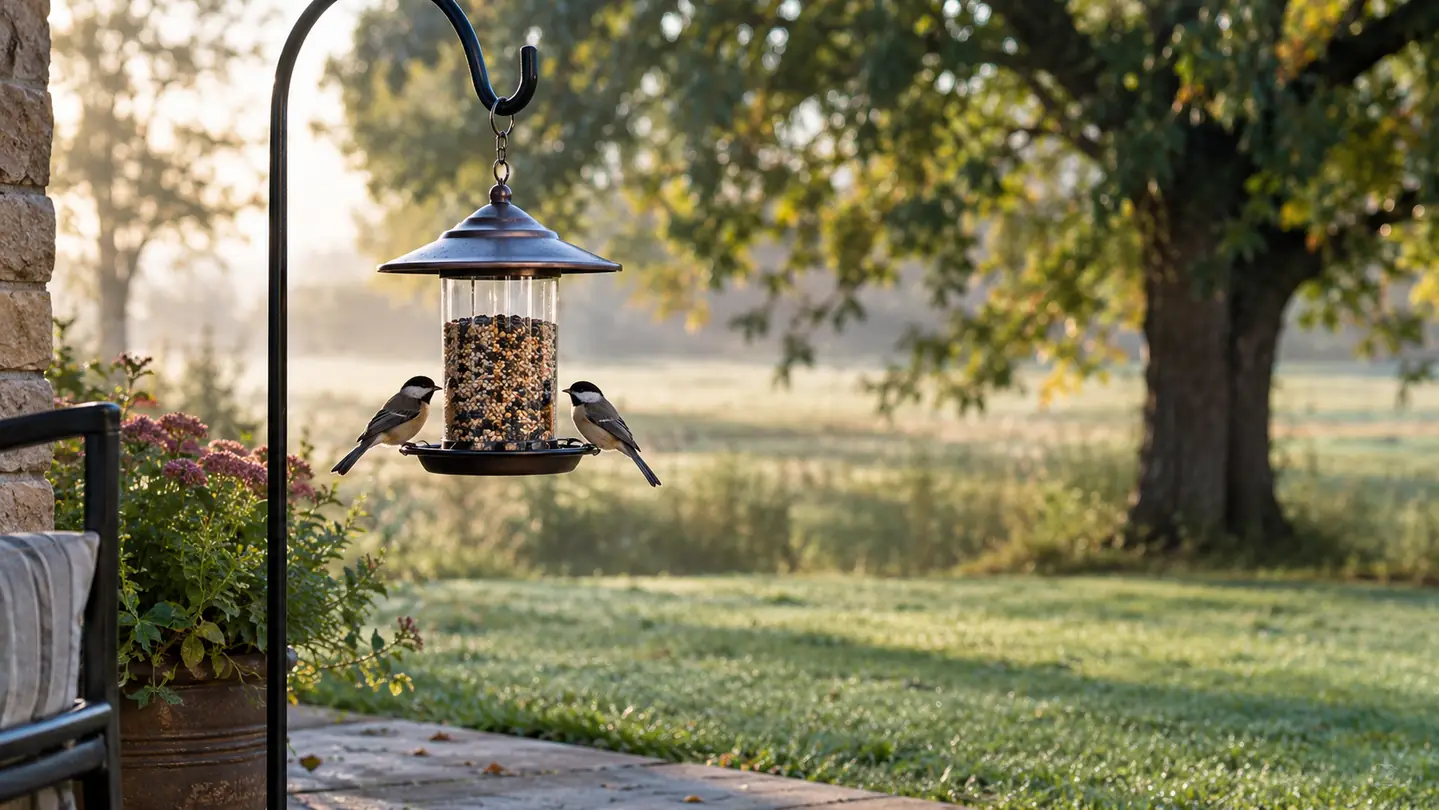
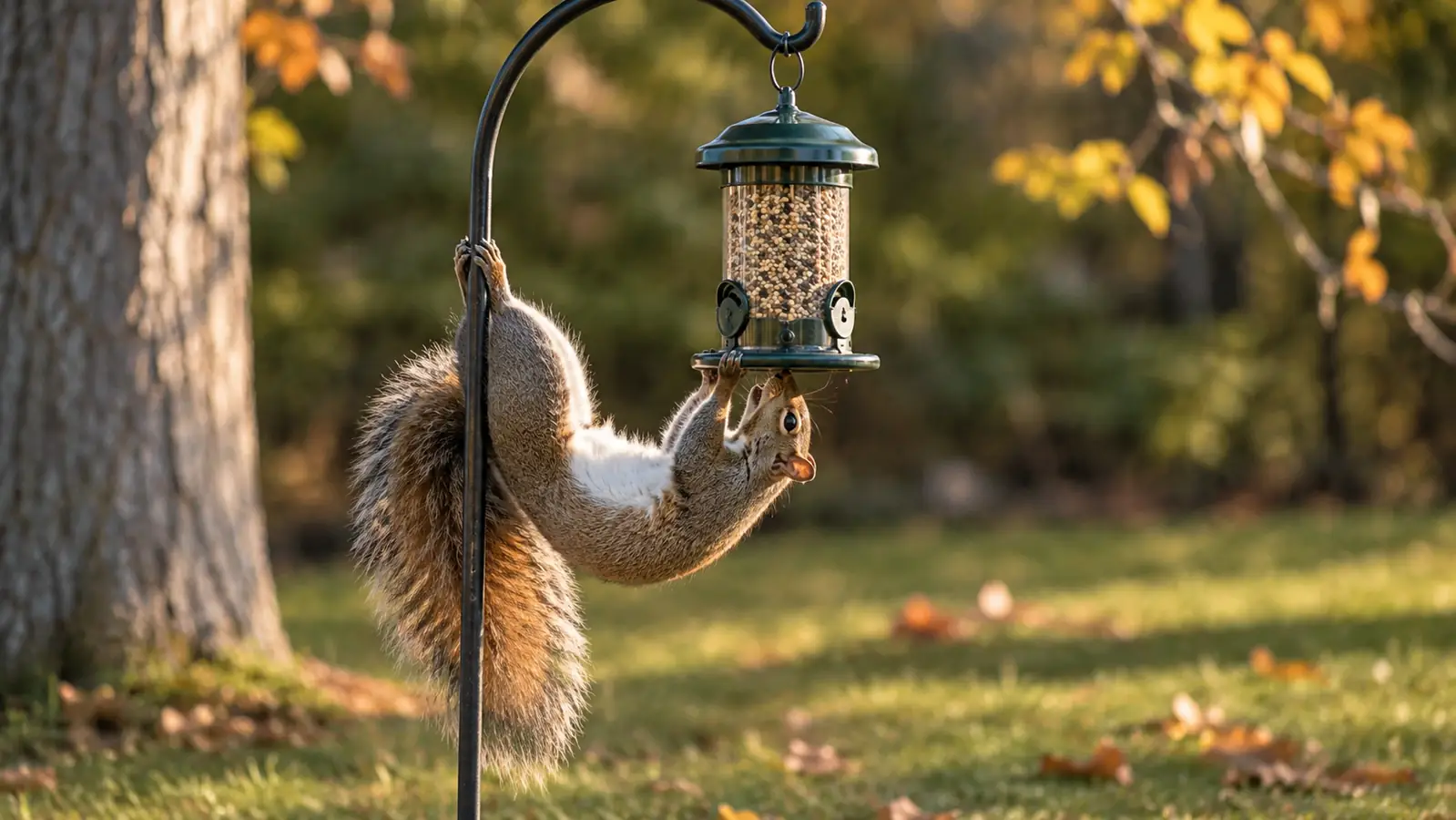
I bought the Brome Squirrel Buster Standard because a squirrel beat me in a staring contest through my own kitchen window. It was spring of 2024, and I had a plain tube feeder hanging off a shepherd's hook beyond the patio. Every morning a squirrel would shimmy up the pole, hang upside down by its back feet, and eat with the calm confidence of a man at a buffet while the cardinals waited in the pecan tree and gave me looks. I am sixty-seven and retired. I have time to be annoyed about things. I was annoyed about that.
What follows is not a review written off a product page. I have run this feeder through two springs, a summer of house finches, one tropical storm that took a fence panel with it, and a fair number of pounds of black oil sunflower seed. The honest version includes the parts that irritated me for the first month, the one thing that still irritates me, and the handful of jobs this feeder simply will not do. If you want a tidy list of praise, there are plenty of those around. This is closer to what I would tell a neighbor over the fence.
The Quick Verdict
It genuinely stops squirrels from eating, and it does it with a spring instead of a motor. The catch is a small seed capacity and an adjustment you will fiddle with twice a year.
Amazon Check Today's Price →The feeder that ended a two-year argument with a squirrel
It hangs on a hook, it needs no batteries, and the shroud closes the ports on its own. Brome backs it with a lifetime limited warranty.
Amazon Check Today's Price on Amazon →How I've Used It
The feeder hangs on the same shepherd's hook, six feet up and about four feet off the patio edge, close enough that I can watch it while the coffee finishes. Installation is hanging it. There is no pole to sink and no bracket to bolt to the house. The feeder measures 5 inches by 5 inches by 13.25 inches and holds 1.3 pounds of seed, which in a hard January with cardinals and house finches working it is about a day and a half, and in the slow heat of August is closer to four days. That number is the first thing I would want to know, and it is the first thing I complain about below.
Before I hung it I did the thing I should have done two years earlier and moved the hook another eighteen inches out from the patio edge, so a squirrel standing on the arm of a chair could not simply reach up and catch the bottom of the feeder. That one change did more than any feeder I have owned. I also went at the hook with a tape measure, because I wanted the bottom of the feeder above Earl's head when he mows, and thirteen and a quarter inches of feeder hanging on a six foot hook clears him by about a hand's width. He has not walked into it once, which is a first.
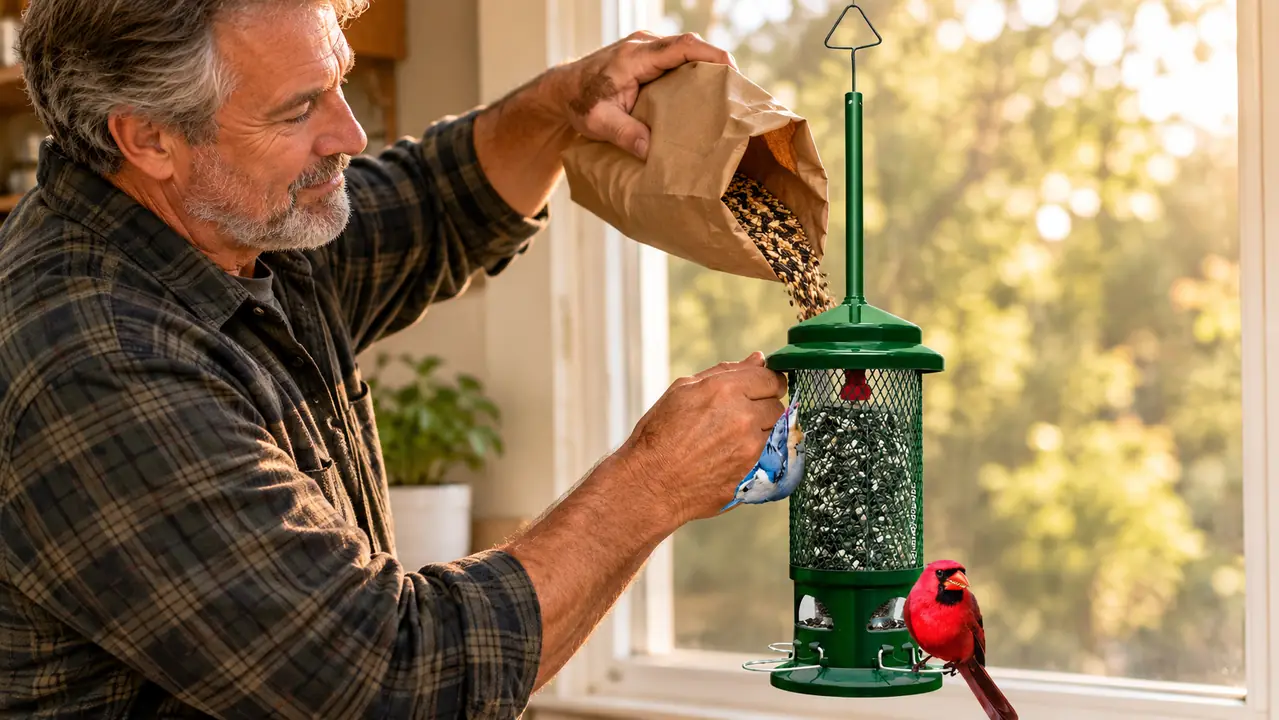
The mechanism is the whole story. A wire shroud hangs over the seed tube, and the openings in that shroud line up with the feeding ports when nothing heavy is on it. A squirrel puts its weight on the shroud, the shroud drops, the openings slide out of line, and the ports close. The spring underneath is adjustable, so you decide how much weight it takes to trip. Set it light and even a big cardinal trips it and goes hungry. Set it heavy and a small squirrel can still feed. I had mine too light for the better part of two weeks and could not work out why the cardinals kept landing, looking, and leaving. Once I started over and tightened it a quarter turn at a time over several days, the traffic sorted itself out.
The thing I did not expect is how much the wire shroud does for the birds that will not use a perch. The Carolina wrens, which cannot sit still on anything to save their lives, cling to the shroud and work the ports sideways. The cardinals use the perches like civilized creatures and take their time. Chickadees do a bit of both and are off to the pecan tree to crack the seed before I have finished my coffee. Perches and shroud together mean a mixed crowd can feed without shoving, which is more than I could say for the tube feeder this replaced.
The storm is worth mentioning. We had a tropical system come through in September that took a fence panel and scattered the patio chairs, and the feeder rode it out on the hook without a crack. The seed got wet through the ports and I had to dump it, but the feeder itself came through fine. That is one data point, not a promise, and it is still more than the last two feeders managed.
What I did not expect was how much of my morning this thing would take over. The kitchen window looks straight at the hook, and I have started drinking my coffee standing up. Earl says I have become one of those people. He is not wrong, and the feeder is the reason.
The Annoyances Nobody Mentions
One and three tenths pounds is not a lot of seed, and I want to say that plainly because it changes how you live with this thing. A neighbor of mine runs a tube feeder that holds several times that, and she fills it on Sunday and forgets it until the following weekend. I fill this one more often, and in a cold snap with a stiff wind I am out there in my robe with a scoop more than I would like. If your birds are serious and your winters are long, the refilling is the daily tax on this feeder.
There was a morning in early February, twenty-eight degrees with a wind coming out of the north, when I filled the tube at seven and looked out at noon to find it three quarters empty with four cardinals still working it. I went out a second time in my robe and slippers, and that seed was gone by the next morning. Two fills in a single day is what this feeder asks of you in the worst week of the year. I would rather tell you that now than have you discover it on a cold morning with your hands full.
Cleaning is the chore I dread and the one nobody mentions in a listing. Hulls and seed dust settle into the bottom of the tube, and in a wet spring that dust turns into a paste the birds will not touch and I have to work out with a bottle brush and a spray from the hose. I do it every few weeks in summer and less in winter. It is not difficult. It is just fiddly, and it never becomes fun.
The wire shroud also sits between you and the seed. On a plain tube feeder you can read the seed line from the kitchen window and know at a glance whether you need to go out. Here you are looking through wire, and I have made the walk to the hook with a full scoop more than once, only to find the tube still half full. Small thing. You learn to tilt your head.
The feeder does not keep squirrels out of my yard. It keeps them from eating. There is a difference, and the difference is a pile of sunflower hulls on my patio.
Which brings me to the ground. Squirrels are not stupid, and they learn inside a week that the payoff is underneath. They will sit below the feeder and take whatever the cardinals knock loose, and the cardinals knock loose plenty. I have also watched a squirrel ride the shroud down, hang there a minute, work out that the ports are shut, and drop off. The feeder did its job in that moment. It did not remove the squirrel from my life.
Anyone who tells you a feeder will solve a squirrel problem is selling something. What this one solves is the specific problem of a squirrel eating the seed out of the feeder. It does nothing about a squirrel on the roof of the shed, in the pecan tree, or sitting on the fence giving you a look. For that you need a baffle, a different hook placement, or patience, and I have tried all three with mixed results.
What It Does Better Than I Expected
There is no battery, no motor, no motion sensor, and nothing to reset after the power blinks. I did not appreciate how much I cared about that until I owned it. The old feeder had a battery door I had to dry out twice a season. This one has a spring, a shroud, and a hook, and when a squirrel trips it, it resets itself the moment the squirrel leaves. I have never once walked out to find it stuck closed with a line of hungry birds on the fence.
I had a battery feeder before this one, and the week the temperature dropped into the teens it stopped tripping altogether. The shroud stayed put, the ports stayed open, and a squirrel ate for two days straight before I noticed the seed going down. I replaced the batteries twice that winter and never trusted the thing again. A spring does not care how cold it is. That is the whole argument for this design in one sentence, and I did not understand it until I had lived with both.
Brome backs this feeder with a lifetime limited warranty, which is a strange thing to see on a plastic feeder and the main reason I stopped looking at the less expensive options. I have not had to use it. I did read the terms before I bought, because I have been burned by the word lifetime before, and it is a real limited warranty rather than a marketing phrase. Whether the company is still around in fifteen years is a fair question, and the honest answer is that I do not know.
The Seed Question
Nobody tells you that the seed matters as much as the feeder. Black oil sunflower is what works here, and it brings the cardinals, the chickadees, the house finches, and the wrens. Safflower is the other one worth trying if the squirrels are relentless, since a lot of them dislike it, though the cardinals will still eat it. What I avoid is a bargain mixed bag with a lot of milo and wheat in it. The birds pick through it, fling the filler onto the ground, and you are refilling a feeder that is somehow still full.
I buy black oil sunflower in a forty pound bag and keep it in a galvanized can with a lid out in the shed, because a paper bag left in the garage draws mice and mice draw Earl's attention. That bag lasts me a little over a month in the busy season, which works out to roughly two fills a week averaged across the year. When I tried a cheaper mix with milo cut into it, the feeder lasted noticeably longer and the birds looked thinner, which told me most of what I needed to know about saving money that way.
Anything with big chunks or heavy hulls will bridge in the tube and stop feeding, and you will not know until you look. The 1.3 pound capacity makes that worse, because a bridged feeder with a small capacity is a feeder that is not feeding. I shake the tube whenever I walk past it, which takes two seconds and saves a wasted morning.
What I Liked
- Stops squirrels with a weight-triggered shroud instead of a motor
- No batteries, no sensor, nothing to reset
- Wire shroud gives clinging birds a place to feed
- Adjustable spring lets you tune it for the birds you actually get
- Lifetime limited warranty from Brome
- Hangs from a hook with no hardware to install
Where It Falls Short
- 1.3 pound capacity means frequent refills
- The spring takes several days of fiddling to dial in
- Wire shroud makes the seed level hard to read
- Hulls and dust collect in the tube and need brushing
- Does nothing about squirrels on the ground or in the tree
Two Things I Would Change
First, the capacity. Give me a version with more seed and I will pay attention. Second, make the shroud easier to see through, so I can read the seed level from the window instead of walking out to check. Neither is a deal breaker and neither is a reason to walk away. They are the two things I think about every week, and I would rather tell you now than have you find out in February.
I would also change the manual. The spring adjustment is the entire system, and the thin printed guidance in the box does not prepare you for it. What worked for me was starting heavy, watching which birds got shut out, and tightening a quarter turn at a time over about a week. Do it on a Saturday when you can sit and watch, not on a Monday when you are leaving for the dentist.
If you want the mechanical differences laid out side by side, the head to head against the Perky-Pet Squirrel Be Gone is a fair fight and I would not call it lopsided. That feeder has its own answer to the same problem, and in some yards it is the better answer. What I will say here is that the Brome is the quieter of the two, in the literal sense of the word, and I have come to value quiet in my back yard. There is also a longer term write-up of how this one has held up if you want the wear and tear detail.
Who This Is For
This is for the person who is tired of being outsmarted and wants a solution with no batteries, no wires, and no pole sunk in concrete. It suits a yard with cardinals, chickadees, finches, and wrens, a hook you can hang from, and a willingness to fill a small feeder often. It especially suits anyone who tried a caged feeder and found that the squirrels chewed through the cage or simply learned to hang off the roof. If that is you, this is the design that finally made sense to me.
Who Should Skip It
Skip it if you want to fill once a week, if your flock includes pigeons or blackbirds that will empty 1.3 pounds before lunch, or if the squirrels in your yard are so numerous that a feeder on a hook is a joke regardless of the mechanism. Skip it if you want the seed level readable from the window without squinting through wire. And skip it if you are hoping to keep squirrels out of the yard entirely, because no feeder does that and this one does not pretend to. For that, spend your effort on placement and a baffle instead.
If the squirrels are winning, this is the argument I finally won
It hangs on a hook, needs no batteries, and the shroud closes the ports by itself. Brome sells it with a lifetime limited warranty.
Amazon Check Today's Price on Amazon →Mine is going into its third spring. I still fill it more often than I would like, and I still mutter about the seed level. I also watched a squirrel drop off the shroud this morning, check the ground, and walk away, and the cardinals were back on the perches inside a minute. That is about the best I can ask of a bird feeder in a yard with a pecan tree in it.